






 Web Based Solutions


 Mobile App Development








 UI/UX Design
 Digital Marketing



 Quality Assurance


 Managed IT Services
 Web Developers











 Mobile App Developers



 Frontend Developers



 Open Source Developers







 Microsoft Certified Developers



 Cross Platform Developers

 Quality Assurance

 Microsoft
 Open Source
 JS Frameworks
 Business Models
 Intellectual Property Protection
 IT Consulting Services
 IT Outsourcing Services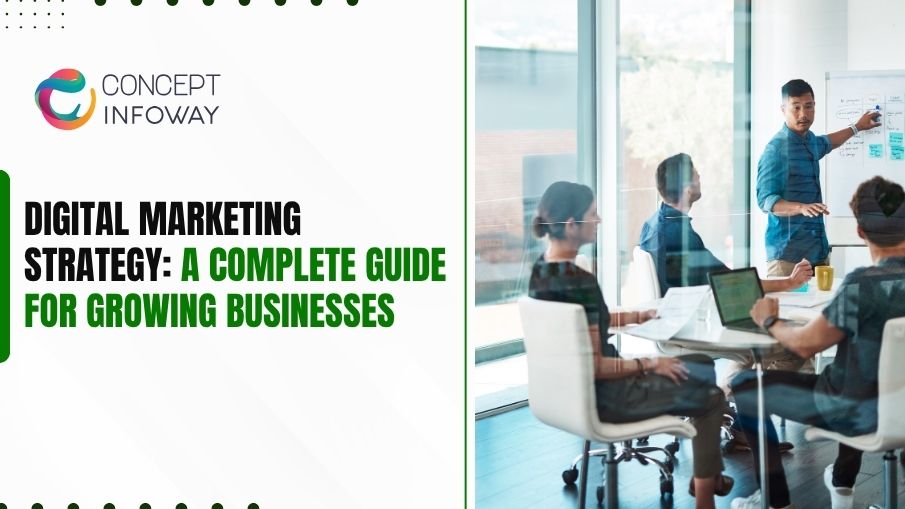
Digital Marketing Strategy: A Complete Guide for Growing Businesses
Digital marketing strategy is what turns scattered promotional activity into a system that can actually support growth.
If your business is spending on ads, content, email, social media, or SEO without a clear plan, it becomes hard to know what is working, what is wasting budget, and where the next opportunity is coming from.
This guide walks through how to build a practical strategy, not just a list of tactics. You will learn how to connect goals, audience insight, channels, content, measurement, and optimization into one plan that supports real business outcomes.
For companies evaluating digital marketing services in the USA, including support from a team like Concept Infoway, the goal is not more activity. It is a better structure for growth.
Digital Marketing Strategy: What It Really Means for Growing Businesses
A strong strategy is more than choosing a few digital channels. It gives your marketing decisions a clear purpose, helps your team avoid wasted effort, and makes it easier to measure progress against business goals. Without that structure, even good campaigns can feel disconnected.
Strategy Is Not the Same as Tactics
Tactics are the individual actions you take, such as running search ads, publishing blog posts, or sending an email campaign. Strategy explains why those tactics are being used, who they are meant to reach, and how they support the customer journey.
That distinction matters because many businesses start with tactics before they understand the outcome they want. A strategy-first approach helps you decide whether the priority is lead generation, ecommerce sales, local visibility, pipeline support, or customer retention.
What a Good Strategy Needs to Include
A useful digital marketing strategy usually defines your business goals, target audience, key channels, content direction, conversion path, and measurement plan. It also clarifies what success looks like in the short term and what should improve over time.
For example, a business trying to grow service inquiries needs a different plan than an ecommerce brand trying to increase repeat purchases. The channel mix, messaging, landing pages, and performance metrics should reflect that difference.
Need a Smarter Way to Grow Online? Get Our Expert Solutions!
Get A Free QuoteWhy Business Growth Depends on Alignment
Marketing works better when the website, campaigns, sales process, and reporting all support the same goal. When those pieces are misaligned, teams often see traffic without leads, leads without conversions, or conversions without profitability.
At Concept Infoway, we often see businesses improve results not by adding more channels, but by tightening the connection between the offer, the audience, and the conversion path.
How to Build an Online Marketing Strategy That Fits Your Business
A practical online marketing strategy starts with understanding what your business needs most. The right approach depends on your growth stage, your margins, your sales cycle, and how customers usually make decisions. A digital marketing strategy helps keep content, targeting, and measurement connected.
Start with the Business Goal, Not the Channel
Before choosing digital marketing channels, define the business outcome you want. That might be qualified leads, booked consultations, more ecommerce revenue, better local visibility, or stronger retention.
Once the outcome is clear, you can reverse-engineer the path to get there. That is usually more effective than asking which platform is trending or which tactic is popular right now. With a digital marketing strategy, businesses can scale what works with less guesswork.
Know Who You Are Trying to Reach
Audience research should go beyond basic demographics. You need to understand what your buyers care about, what they search for, where they spend time online, what objections they raise, and what makes them take action.
A marketing plan for executives will look different from one aimed at first-time buyers, repeat customers, or technical decision-makers. When the message matches the audience’s real concerns, conversion rates usually improve because the content feels relevant instead of generic.
Map the Customer Journey Before You Spend
A good strategy accounts for the full path from awareness to decision. Some people need educational content before they are ready to talk to sales, while others are already comparing providers and need proof, clarity, and a low-friction next step.
A practical digital marketing strategy also prevents campaigns from drifting out of alignment.
This is where a marketing funnel strategy becomes useful. Top-of-funnel content may attract attention, middle-of-funnel content may build confidence, and bottom-of-funnel content may help close the sale. The mix should reflect how people actually buy in your market.
Want More Leads and Customers? Get Our Experts Help!
Get A Free QuoteWhich Digital Marketing Channels Should You Use?
The best digital marketing channels are the ones that fit your audience, budget, sales cycle, and internal capacity. No channel performs well in isolation. The real value comes from using the right mix and connecting those channels to a strong website and conversion process.
Search, Social, Email, and Paid Media Each Play a Different Role
Search engine optimization helps your business show up when people are actively looking for solutions. Paid search can capture intent faster, especially when timing matters.
Social media can support awareness, trust, and retargeting. Email is often one of the strongest tools for nurturing and repeat engagement. A digital marketing strategy should make growth decisions easier, not more complicated.
A healthy online marketing strategy often combines more than one channel because buyers do not usually move in a straight line.
They may discover your brand on social, research you through search, and convert after receiving a targeted email or seeing a remarketing ad. A digital marketing strategy keeps that decision connected to the larger growth plan.
Why Your Website Is the Hub of the Strategy
Your website is where traffic turns into action. If the site is slow, unclear, hard to navigate, or inconsistent with your message, strong campaigns can still underperform. The goal is to build a digital marketing strategy that can improve over time.
That is why a website marketing strategy matters. Landing pages, service pages, forms, calls to action, and trust signals should all support the decision you want visitors to make.
Concept Infoway often helps businesses connect marketing efforts with website design, development, and optimization so the traffic they earn has a better chance of converting.
Build a Channel Mix You Can Sustain
A common mistake is launching too many channels at once. That spreads budget, attention, and reporting too thin. It is usually better to start with a manageable mix, prove what works, and then expand deliberately.
If your team cannot create content consistently, manage paid campaigns well, or respond to leads quickly, the strategy should account for those limits.
The right plan is the one your business can execute well, not the one with the most moving parts. A digital marketing strategy gives this answer a more practical business lens.
You may also like: SEO Strategy: A Complete Guide to Ranking Higher in Local Search
How Do You Measure Marketing ROI and Know What Is Working?
Marketing ROI measurement is what separates activity from accountability. If you cannot connect performance to business results, it becomes difficult to justify spend, refine strategy, or decide where to invest next. A strong digital marketing strategy also helps Concept Infoway align marketing with website performance.
Define the Metrics That Match the Goal
The right metrics depend on the outcome you want. For lead generation, that may include qualified leads, cost per lead, conversion rate, and pipeline contribution.
For ecommerce, it may include revenue, average order value, repeat purchase rate, and return on ad spend. That makes a digital marketing strategy useful for both planning and execution.
Not every metric deserves the same attention. Traffic can be useful, but it does not matter much if the visitors never become customers. A good measurement plan focuses on the numbers that actually support growth. A focused digital marketing strategy keeps the website and campaigns working together.
Set Up Tracking Before Scaling Spend
One of the biggest mistakes businesses make is increasing spend before they have reliable tracking in place. If form fills, calls, purchases, and key engagement actions are not being measured correctly, reporting can give a false picture of success.
Before scaling campaigns, check that analytics, conversion tracking, attribution settings, and platform integrations are working. This step is often overlooked, but it is one of the most valuable parts of a digital marketing strategy because it protects your budget from blind spots.
Read Performance as a System, Not in Isolation
A channel may look weak on its own while still supporting the broader funnel. For example, a social campaign might not drive direct conversions, but it could help create branded search demand or assist later-stage decisions.
That is why performance reviews should look at the complete path. When we evaluate campaigns at Concept Infoway, we look at how the website, message, audience targeting, and conversion flow work together instead of judging each data point alone.
You may also like: Technical SEO Audit for Dental Websites: A Complete Guide
What Makes a Strategy Effective over Time?
A digital marketing strategy is only useful if it can adapt. Markets change, competitors adjust, platforms evolve, and customer expectations shift. The businesses that improve over time are usually the ones that review, test, and refine their approach regularly.
Test Small, Learn Fast, Then Scale
You do not need to rebuild your entire plan every time results slow down. Often, the smartest move is to test one variable at a time, such as a message, a landing page, a CTA, or a targeting segment.
That approach helps you learn what is actually influencing performance. It also reduces the risk of changing too many things at once and losing visibility into what caused the result.
Keep Content and Campaigns Consistent with the Buyer Journey
If your ads promise one thing and your landing page says another, prospects notice. If your blog content targets early-stage research but your calls to action are only designed for ready-to-buy visitors, you lose opportunities.
Consistency matters because trust builds through repetition and clarity. The strongest strategies align content, design, and offer around the same intent so the user experience feels coherent from first click to conversion. A well-built digital marketing strategy turns channel choices into a coordinated system.
Refresh the Strategy When the Business Changes
A strategy should evolve when your business launches a new service, expands into a new market, changes pricing, or shifts its sales process. What worked last year may no longer fit the new version of the business. The best digital marketing strategy supports decisions before, during, and after each campaign.
That is especially important for companies growing across regions or working with digital marketing USA audiences that may behave differently by market. Reassessing your plan helps keep campaigns aligned with current priorities instead of old assumptions. A durable digital marketing strategy should adapt as goals and markets change.
How to Choose the Right Support for Digital Marketing Services in the USA
Many businesses can handle pieces of digital marketing in-house, but few teams have the time and specialist skills to manage everything well.
Choosing the right support is about finding a partner that understands your business model, your goals, and the operational side of execution. A digital marketing strategy gives performance reviews a clearer business context.
Look for Strategy, Not Just Production
A service provider should be able to explain why a tactic matters, how it fits your funnel, and what success should look like.
If the conversation is only about posting more content or running more ads, the bigger strategic picture may be missing. Every digital marketing strategy should connect audience intent with measurable business outcomes.
The best digital marketing services in USA markets usually combine planning, execution, and measurement. That may include SEO services, paid media, content, website improvements, and conversion support, depending on the needs of the business. A clear digital marketing strategy helps teams decide what to prioritize next.
Ask How They Tie Marketing to Business Outcomes
You want a partner who can speak about leads, revenue, customer quality, and lifecycle value, not just impressions or clicks. The real question is whether the work is helping your business grow in a sustainable way. This is where a digital marketing strategy turns activity into direction.
That is where Concept Infoway fits naturally for businesses that need a practical, website-aware approach to digital growth. Our team supports marketing strategy, web design, development, optimization, and related services that help campaigns perform more effectively once visitors arrive. The right digital marketing strategy makes each channel easier to evaluate.
You may also like: Digital Marketing Metrics That Matter: KPIs Every Business Should Track
Choose a Team That Can Grow with You
The right support should be able to adjust as your needs change. A business that starts with SEO may later need PPC, landing page work, app support, ecommerce improvements, or broader digital infrastructure.
A flexible partner can reduce the friction of scaling because you do not have to restart the relationship every time your priorities change. That continuity can make planning and execution much easier over time.
Wrapping Up
A strong digital marketing strategy gives your business direction, focus, and a better way to measure progress. Instead of guessing which tactic to use next, you build a plan around goals, audience needs, channel fit, website performance, and marketing ROI measurement.
The businesses that grow with more confidence are usually the ones that treat marketing as a system, not a collection of disconnected tasks.
If you are evaluating digital marketing services in the USA, Concept Infoway can help you think through the strategy, support the website and development side, and build a practical path toward better results.
FAQs - Digital Marketing Strategy
What Is a Digital Marketing Strategy?
A digital marketing strategy is a structured plan for reaching business goals through online channels. It defines your audience, message, channels, website path, and success metrics so your marketing has a clear purpose.
Why Does a Business Need a Digital Marketing Strategy?
A strategy helps you spend budget more wisely and measure what is working. Without one, campaigns can feel random, making it harder to connect traffic, leads, and revenue to real business outcomes.
What Should Be Included in an Online Marketing Strategy?
A solid online marketing strategy should include business goals, audience research, channel selection, content planning, website conversion steps, and marketing ROI measurement. Those pieces keep the plan focused and measurable.
Which Digital Marketing Channels Work Best for Growing Businesses?
The best mix depends on your audience and sales cycle. SEO, paid search, social media, email, and website optimization often work well together when they support the same customer journey.
How Do You Measure Marketing ROI?
Marketing ROI is measured by comparing the value generated from campaigns against the cost to run them. The exact metrics vary by goal, but tracking leads, revenue, conversions, and cost per acquisition is usually essential.
What Is the Role of a Website Marketing Strategy?
A website marketing strategy makes sure your site turns traffic into action. It aligns page structure, messaging, forms, calls to action, and trust signals so visitors have a clearer path to convert.
How Often Should a Digital Marketing Strategy Be Updated?
A strategy should be reviewed regularly and updated when performance changes, the market shifts, or your business goals change. Many businesses benefit from monthly performance checks and deeper quarterly reviews.
Can Concept Infoway Help with Digital Marketing Services in the USA?
Yes. Concept Infoway supports businesses with digital marketing, website design, development, optimization, and related services that help campaigns perform better and align with business goals.


7 Keys Ecommerce Marketing Trends Driving Online Sales