







 Web Based Solutions


 Mobile App Development








 UI/UX Design
 Digital Marketing



 Quality Assurance


 Managed IT Services
 Web Developers











 Mobile App Developers



 Frontend Developers



 Open Source Developers







 Microsoft Certified Developers



 Cross Platform Developers

 Quality Assurance

 Microsoft
 Open Source
 JS Frameworks
 Business Models
 Intellectual Property Protection
 IT Consulting Services
 IT Outsourcing Services
7 Keys Ecommerce Marketing Trends Driving Online Sales
Ecommerce marketing trends are changing how online stores attract shoppers, earn visibility, and turn product interest into sales. Many businesses are investing in more channels, yet still struggle to connect SEO, paid campaigns, content, video, and conversion improvements into one measurable growth system.
The most useful trends are not simply the newest tools or platforms. They are practical shifts in how customers search, compare, evaluate, and purchase online.
This guide explains seven trends worth prioritizing, how they support ecommerce SEO services and lead generation, and how to decide where your budget and internal resources will have the greatest impact.
Understanding Which Ecommerce Marketing Trends Actually Drive Sales
Not every popular tactic deserves a place in your ecommerce marketing plan. A trend becomes commercially useful when it helps the right shopper discover a product, understand its value, trust the business, and complete the purchase with less friction.
That process usually involves several touchpoints. A customer may first see a short video, later search for product comparisons, visit a category page from an organic result, read reviews, and return through a paid ad before buying.
If each channel is managed separately, the customer experience becomes inconsistent and the business has difficulty identifying what influenced the sale. This is one way ecommerce marketing trends affect planning.
Start With the Customer Journey, Not the Channel
A practical ecommerce strategy begins by mapping the questions customers ask at each stage. Someone discovering a problem needs educational content. Someone comparing products needs clear specifications, reviews, demonstrations, and transparent policies.
Someone ready to buy needs fast pages, accurate inventory information, simple checkout, and confidence that the transaction is secure. That priority is increasingly visible across ecommerce marketing trends.
This distinction matters because the same keyword or campaign can represent different levels of intent. A search for “best running shoes” is not equivalent to “buy women’s trail running shoes size 8.” The first may require comparison content and category guidance.
The second should lead to a relevant product or filtered category page. This is one way ecommerce marketing trends affect planning.
Use a Commercial Filter for Every Trend
Before adopting a new tactic, ask four questions:
- Does it reach a clearly defined audience with a relevant need?
- Does it improve discovery, consideration, conversion, retention, or more than one stage?
- Can the business measure a meaningful action beyond impressions or clicks?
- Can the team maintain the content, technology, and customer experience after launch?
These questions help prevent a common mistake: adding more marketing activity without fixing the pages, offers, tracking, or fulfillment experience that determine whether traffic becomes revenue. This is one way ecommerce marketing trends affect planning.
For example, a retailer may increase traffic through ecommerce search engine marketing but see weak results because its landing page shows too many products, loads slowly, or does not answer shipping and return questions. In that situation, increasing ad spend may amplify the underlying problem rather than solve it.
An experienced SEO company in USA serving ecommerce businesses should therefore look beyond rankings. The work should connect technical health, search intent, merchandising, content quality, user experience, and business measurement. The goal is not to follow every trend.
It is to build a system that makes profitable customer journeys easier to repeat.
Grow Your Online Store with Modern Marketing Solutions!
Get A Free QuoteSeven Ecommerce Marketing Trends Worth Prioritizing
The following seven trends are closely connected. Together, they show how ecommerce brands can create stronger discovery, more useful shopping experiences, and better opportunities for conversion. The right order depends on your current technical condition, product margins, customer behavior, and measurement maturity.
Search Experiences Are Becoming More Intent-Focused
Search visibility now depends on how well a page satisfies a shopper’s underlying need, not just whether it repeats a product phrase. Search engines increasingly evaluate whether content is useful, specific, trustworthy, and aligned with the query. This shift is part of broader ecommerce marketing trends.
For ecommerce teams, this means optimizing more than product titles. Category pages should explain what makes the products different and help shoppers narrow their choices. Product pages should include original descriptions, practical use cases, specifications, sizing or compatibility information where relevant, review content, shipping details, and clear next actions.
This shift is part of broader ecommerce marketing trends.
A sound ecommerce SEO strategy also requires technical consistency. Important products should be discoverable and indexable. Filters should not create uncontrolled duplicate URLs. Product availability should be represented accurately.
Structured data should match what users can see on the page, and internal links should help both shoppers and search engines understand the relationship between categories, collections, and products. That consideration helps businesses interpret ecommerce marketing trends.
The commercial lesson is simple: optimize pages around decisions. A page that answers “Which product is right for my situation?” Is often more valuable than one that only claims to offer quality or affordability.
First-Party Data Is Becoming More Valuable
Changes in privacy expectations and tracking capabilities make it less reliable to depend entirely on third-party audience signals. Ecommerce companies are placing greater value on information they collect directly and responsibly through their own customer interactions.
Useful first-party data can include email subscriptions, purchase history, product preferences, on-site search behavior, customer service questions, and consented feedback. The value comes from using that information to improve relevance, not from collecting as much as possible. That priority is increasingly visible across ecommerce marketing trends.
A store might use a customer’s stated interest in a product category to send a useful buying guide, notify them about relevant availability, or recommend compatible products after a purchase. Clear consent practices and an easy way to manage communications are essential.
Requirements can vary by jurisdiction and business situation, so privacy processes should be reviewed carefully rather than copied from another company.
First-party data also improves strategic decisions. If customer questions repeatedly mention installation, sizing, delivery timing, or compatibility, those questions can guide content, product-page improvements, and merchandising decisions. This shift is part of broader ecommerce marketing trends.
According to industry reports, the global SEO services market is projected to grow from USD 74.9 billion in 2025 to USD 83.98 billion in 2026 and reach approximately USD 148.86 billion by 2031. This represents a compound annual growth rate (CAGR) of 12.12% from 2026 to 2031.
Short-Form Video Is Supporting Product Discovery
Ecommerce video marketing is no longer limited to polished brand commercials. Short demonstrations, product comparisons, unboxing content, setup instructions, customer use cases, and behind-the-scenes explanations can help shoppers understand products faster.
Video is particularly useful when a product has physical features that are difficult to communicate through static images. A demonstration can show scale, movement, texture, setup, or performance in a real context. It can also address objections before a shopper contacts support or abandons the purchase.
That priority is increasingly visible across ecommerce marketing trends.
The strongest approach is to create video for a defined question. “How does this work?” And “Which version should I choose?” Are more useful starting points than “We need a video for social media.”
Each video should have a clear destination, such as a product page, comparison guide, or collection page, and its claims should match the information presented elsewhere.
Production quality matters, but usefulness matters more. A clear phone-recorded demonstration may outperform a highly produced video that does not show the product in use. Add accurate titles, descriptions, captions, and supporting text so the information remains accessible and discoverable. This shift is part of broader ecommerce marketing trends.
Paid Search and Organic SEO Are Working More Closely Together
Ecommerce search engine marketing can generate immediate visibility for selected products and commercial queries, while organic SEO builds durable visibility over time. Treating these channels as competitors often creates unnecessary friction between marketing teams.
Paid search data can reveal which product language, benefits, and search terms attract qualified visitors. That information can inform category copy, product titles, comparison pages, and content planning. Organic search performance can also reveal where paid coverage may be useful, especially for high-value terms where competitors occupy prominent results.
That consideration helps businesses interpret ecommerce marketing trends.
However, paid and organic results should not be combined into one vague performance number. Measure the role each channel plays, including assisted conversions, new customer acquisition, repeat purchases, margin, and the quality of landing-page engagement.
A keyword with many clicks may still be unattractive if the traffic has low buying intent or the product economics cannot support the acquisition cost.
The best setup gives each channel a job. Paid campaigns can support launches, seasonal demand, competitive product categories, and controlled testing. SEO can strengthen product discovery, educational content, category authority, and long-term nonbrand visibility. That priority is increasingly visible across ecommerce marketing trends.
Shopping Journeys Are Becoming More Personalized
Customers expect stores to help them find relevant products without forcing them to navigate a large catalog alone. Personalization can include useful recommendations, recently viewed products, location-aware availability where appropriate, tailored email content, or guided product selection.
Personalization should reduce effort rather than make the experience feel intrusive. A recommendation is helpful when it is connected to the shopper’s current task. Showing unrelated products because they were popular with someone else can distract from the purchase. This is one way ecommerce marketing trends affect planning.
Start with simple, explainable improvements. Related-product modules, compatibility suggestions, bundles, and category filters can often provide value without requiring an elaborate personalization platform. Monitor whether these features improve product discovery, average order value, repeat purchases, or support outcomes.
If a feature adds visual complexity but does not improve decisions, it may not justify its maintenance cost. This shift is part of broader ecommerce marketing trends.
Conversion Optimization Is Moving Beyond the Checkout Button
Conversion rate optimization is not only about changing button colors or testing headlines. It is the disciplined process of identifying where shoppers hesitate and reducing unnecessary uncertainty throughout the journey.
Common friction points include unclear product differences, weak images, missing dimensions, limited payment information, unexpected shipping costs, complicated returns, slow mobile performance, and forms that ask for unnecessary information. These issues can affect conversion before a shopper ever reaches checkout. That consideration helps businesses interpret ecommerce marketing trends.
Review the full path from landing page to confirmation. Compare behavior by device, traffic source, new versus returning visitor, product category, and customer value where the data is reliable.
A high-level conversion rate may hide important differences; a campaign can appear weak overall while performing well for a specific audience or product group. This is one way ecommerce marketing trends affect planning.
Testing should follow evidence. If customer support receives repeated questions about compatibility, improve the product page before testing minor design changes. If mobile shoppers drop off after shipping costs appear, clarify delivery expectations earlier.
Small improvements to trust and clarity can be more valuable than a long list of cosmetic experiments.
Retention and Customer Lifetime Value Are Central to Growth
Acquiring a customer is only one part of ecommerce growth. For businesses with repeat-purchase potential, retention can improve the economics of marketing and create a stronger base for future sales. That priority is increasingly visible across ecommerce marketing trends.
Retention begins with the experience after the order. Accurate updates, useful onboarding, clear care instructions, responsive support, and a relevant follow-up message all influence whether the customer returns. Post-purchase content can also reduce product misuse and unnecessary support requests.
Segment follow-up communication by customer behavior and product context. A replenishment reminder may suit a consumable product, while a setup guide or accessory recommendation may better serve a durable product. Avoid sending every customer the same discount sequence; frequent discounts can weaken perceived value and train customers to delay purchases.
Retention also creates useful feedback. Repeat customers can identify product gaps, confusing instructions, and new use cases that first-time visitors may not mention. Feed those insights back into SEO content, product information, and ecommerce lead generation campaigns.
You may also like: SEO and Content Strategy: The Complete Guide to Search Visibility
Ready to Grow Your Ecommerce Brand? Get Expert Support!
Get A Free QuoteTurning Trends Into an Ecommerce Growth Plan
ecommerce marketing trends have limited value until it becomes a prioritized action with an owner, a measurement plan, and a realistic maintenance process. The most effective roadmap usually starts with the weaknesses that affect every channel, then adds targeted growth initiatives.
Fix the Foundation Before Expanding Reach
Begin with a technical and commercial review of the store. Check whether search engines can access important pages, whether mobile users can complete key tasks, and whether analytics distinguish meaningful events from casual browsing.
Review page speed, indexation, redirects, duplicate content, structured data, internal linking, broken paths, and product availability signals. That priority is increasingly visible across ecommerce marketing trends.
Then inspect the shopping experience. Are categories organized around how customers shop? Can a new visitor understand the primary product differences? Are shipping, returns, warranty, sizing, compatibility, and payment details easy to find? Does the checkout work smoothly on the devices your customers use most?
These checks should not be treated as separate from SEO. A technically accessible page that fails to answer buying questions will not perform as well as it could. Likewise, persuasive content cannot compensate for a broken mobile checkout. This is one way ecommerce marketing trends affect planning.
Build a Priority Matrix
Rank opportunities using four factors: expected business impact, confidence in the evidence, implementation effort, and operational dependency. A category-page improvement supported by search data and customer questions may deserve priority over a new channel that requires unfamiliar creative, tracking, and staffing. That priority is increasingly visible across ecommerce marketing trends.
A practical sequence might look like this:
- First, resolve technical, tracking, and conversion problems that affect existing traffic.
- Next, improve high-value category and product pages around search intent and customer objections.
- Then, test targeted video, paid search, email, or lead-generation campaigns connected to specific products and audiences.
The exact order will vary. A new store may need product architecture and measurement first, while an established retailer may have enough data to focus on high-margin categories, returning customers, or underperforming landing pages. That consideration helps businesses interpret ecommerce marketing trends.
Connect Content With Merchandising
Content should not operate in a separate editorial lane. Search data can reveal demand for product comparisons, use cases, sizing help, maintenance guidance, and alternative solutions. Merchandising teams can add product knowledge, availability context, margin considerations, and customer feedback. This shift is part of broader ecommerce marketing trends.
For example, a store selling technical equipment may publish a comparison guide that helps readers choose between models. The guide should link to appropriate products, explain meaningful differences, disclose limitations, and remain consistent with inventory and product specifications.
If the content promises a feature that is unavailable in the recommended product, the resulting trust damage can outweigh the traffic benefit.
This is where a specialist team can add value. Concept Infoway’s SEO and digital marketing work can support businesses that need to connect technical optimization, content planning, ecommerce pages, and campaign execution instead of managing each activity in isolation. That consideration helps businesses interpret ecommerce marketing trends.
Plan for Maintenance, Not Just Launch
Ecommerce sites change constantly. Products are discontinued, categories are renamed, promotions expire, inventory fluctuates, and platform updates affect templates or tracking. A strategy that works at launch can decline if nobody reviews it.
Assign responsibility for routine checks. Review priority pages, search performance, conversion paths, internal links, structured data, product feeds, and campaign landing pages at a frequency appropriate to the store’s size and rate of change. Document major changes so performance shifts can be investigated rather than guessed at.
That consideration helps businesses interpret ecommerce marketing trends.
The strongest ecommerce SEO strategies are repeatable. They include a process for finding opportunities, implementing improvements, checking quality, measuring outcomes, and learning from customer behavior.
Measuring the Business Impact of Ecommerce Marketing
Measurement should help decision-makers determine what to keep, improve, reduce, or stop. It should not produce a dashboard full of numbers that no one can connect to business results. This is one way ecommerce marketing trends affect planning.
Use Metrics That Match the Growth Stage
Early-stage analysis may focus on indexation, qualified impressions, landing-page engagement, product discovery, and completed tracking. As the store generates more data, teams can evaluate organic revenue, conversion rate by landing page, assisted conversions, customer acquisition cost, repeat purchase rate, average order value, gross-margin contribution, and customer lifetime value.
No single metric tells the whole story. Revenue growth can hide lower margins. A higher conversion rate can result from a temporary discount. More organic traffic can be unhelpful if it comes from informational searches with little relationship to the catalog.
Interpret performance in the context of product economics, seasonality, promotions, inventory, and customer quality. That priority is increasingly visible across ecommerce marketing trends.
Measure the Journey Across Channels
Attribution is imperfect, especially when customers move between devices, browsers, platforms, and offline interactions. Still, a consistent measurement framework is better than evaluating every channel only by its last click. That consideration helps businesses interpret ecommerce marketing trends.
Compare first-touch discovery, returning visits, assisted interactions, branded search growth, product-page engagement, and completed purchases. Use campaign tagging and reliable event definitions. Reconcile analytics with order data where possible, since platform reports may use different attribution windows and conversion rules.
A useful monthly review asks practical questions: Which pages attracted qualified shoppers? Where did customers hesitate? Which campaigns produced profitable orders or promising leads? Which content supported sales even when it was not the final click? What changed in the product catalog or customer experience that could explain the result?
That priority is increasingly visible across ecommerce marketing trends.
You may also like: How to Maximize ROI with PPC Advertising Management
Watch for Misleading Signals
Vanity metrics are not always useless, but they should not drive major investment alone. Video views, social engagement, rankings, and click-through rates become more meaningful when connected to an action such as a product visit, email subscription, qualified ecommerce lead, add-to-cart event, or purchase.
That consideration helps businesses interpret ecommerce marketing trends.
Also avoid judging SEO too quickly after a technical or content change. Search visibility can fluctuate, and commercial outcomes may require enough time and data to distinguish a real pattern from normal variation.
At the same time, patience should not become an excuse for ignoring obvious problems such as incorrect tracking, broken pages, or irrelevant traffic.
A qualified SEO company in USA should be willing to explain what is known, what is uncertain, what has changed, and what will be tested next. Clear reporting is part of responsible growth work because it gives business owners a basis for making budget decisions.
Wrapping Up
The most valuable ecommerce marketing trends are the ones that improve the complete customer journey: relevant discovery, useful product information, credible demonstrations, coordinated paid and organic visibility, lower-friction shopping, and stronger post-purchase relationships.
Start with the fundamentals that affect every channel. Make important pages technically accessible, align content with real buying questions, improve product and category experiences, and establish measurement that reflects revenue quality rather than activity alone.
Then prioritize the ecommerce marketing trends that fit your customers, catalog, margins, team, and growth stage.
Ecommerce SEO services and broader digital marketing support can be especially useful when technical work, content, paid search, video, and conversion improvements need to operate as one plan. Concept Infoway can help businesses evaluate those connected opportunities and build a practical path from search visibility to stronger online sales.
The right next step is a focused review of your store, customer journey, and current data—not an attempt to adopt every new tactic at once.
FAQs - Ecommerce Marketing Trends
What are the most important ecommerce marketing trends for online retailers?
Key trends include intent-focused SEO, first-party data, short-form product video, coordinated paid and organic search, personalization, conversion optimization, and customer-retention marketing.
How do ecommerce marketing trends affect SEO strategy?
They make SEO more connected to the full shopping journey. Product and category pages must answer buying questions, support mobile users, reflect real inventory, and reduce uncertainty before purchase.
What should an ecommerce business fix before investing in new marketing channels?
Check indexation, mobile usability, page speed, analytics, product information, navigation, shipping details, checkout, and returns first. More traffic will not solve a weak or confusing shopping experience.
How can ecommerce video marketing increase product sales?
Useful demonstrations, comparisons, setup videos, and customer-use examples help shoppers understand products and overcome objections. Link each video to a relevant page and keep its claims accurate.
Should an ecommerce business prioritize SEO or ecommerce search engine marketing?
Most stores can benefit from both. Paid search supports targeted and time-sensitive visibility, while SEO builds broader organic discovery. Assign each channel a clear role and measure profitability separately.
How can ecommerce businesses generate better leads instead of just more traffic?
Use ecommerce marketing trends as a planning lens: match content and landing pages to specific customer needs, offer useful guides or product selectors, use clear calls to action, and qualify leads with relevant forms rather than maximizing low-intent visits.
How long does it take for ecommerce SEO strategies to produce results?
Timing varies with site condition, competition, content quality, authority, catalog size, and implementation speed. SEO should be evaluated through documented changes and trends, not a guaranteed deadline.
How can an SEO company in USA support an ecommerce marketing plan?
A qualified team can audit technical SEO, improve product and category pages, align content with intent, connect organic and paid insights, strengthen measurement, and prioritize work around business goals.

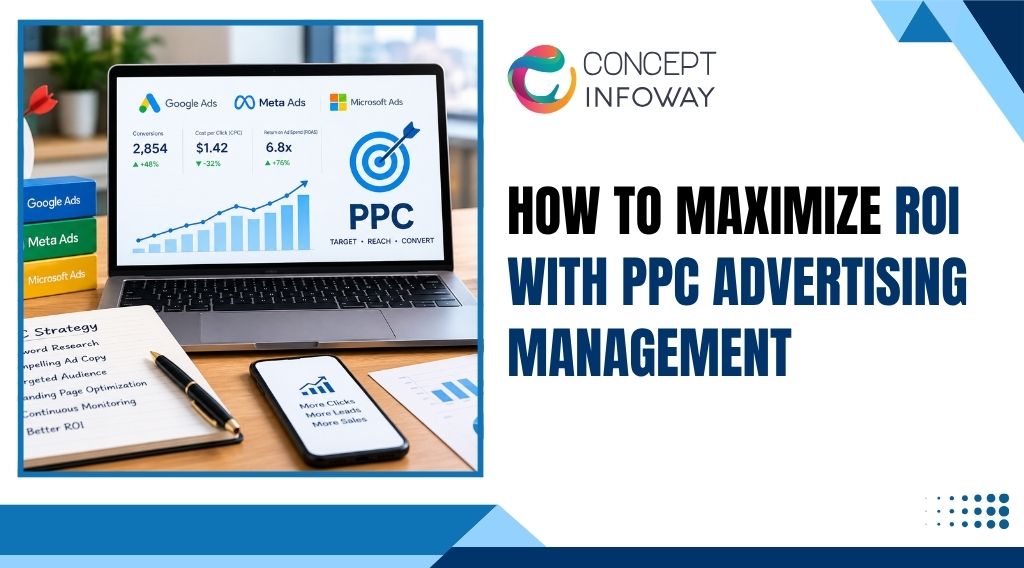
How to Maximize ROI with PPC Advertising Management