







 Web Based Solutions



 Mobile App Development








 UI/UX Design
 Digital Marketing



 Quality Assurance


 Managed IT Services
 Web Developers











 Mobile App Developers



 Frontend Developers



 Open Source Developers







 Microsoft Certified Developers



 Cross Platform Developers

 Quality Assurance

 Microsoft
 Open Source
 JS Frameworks
 Business Models
 Intellectual Property Protection
 IT Consulting Services
 IT Outsourcing Services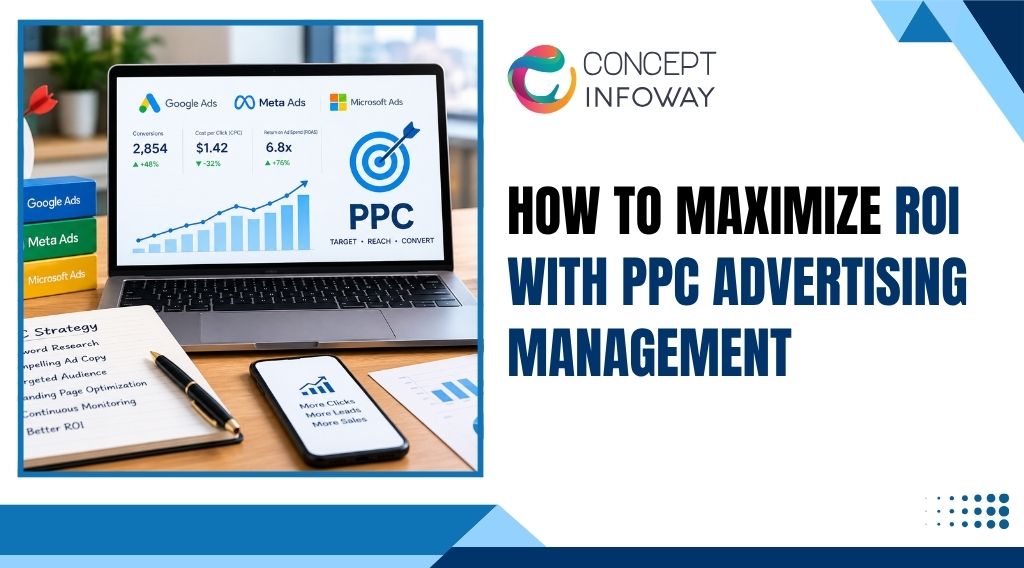
How to Maximize ROI with PPC Advertising Management
PPC Advertising Management can help your business generate qualified traffic quickly, but spending more on ads does not automatically produce a better return. Without disciplined targeting, conversion tracking, testing, and budget control, even a well-funded campaign can attract expensive clicks that never become customers.
This guide explains how to maximize return on investment from pay per click advertising by connecting campaign decisions to business outcomes.
You will learn how to set useful targets, structure campaigns, improve ad relevance, control wasted spend, evaluate PPC advertising services, and build a practical optimization process with a partner such as Concept Infoway.
Understanding What ROI Really Means in PPC Advertising Management
PPC performance should be measured by the value generated after a click, not by traffic volume alone. A campaign may receive many clicks and still lose money if the visitors are poorly matched, the landing page is weak, or the conversion data is incomplete.
Start With a Business-Level Goal
The first step in effective PPC advertising management is deciding what the campaign must achieve. Common goals include generating qualified leads, increasing completed purchases, promoting a high-margin product, filling appointment slots, or creating demand in a new market.
Those goals require different measurements. An ecommerce campaign may focus on revenue, profit margin, average order value, and return on ad spend. A professional service campaign may need to track lead quality, booked consultations, sales acceptance, and revenue per customer rather than form submissions alone.
A useful objective is specific enough to guide decisions. For example, “increase website traffic” is too broad to determine whether a keyword deserves more budget. “Generate qualified consultation requests at a sustainable cost while maintaining sales follow-up capacity” gives the marketing and sales teams a more practical standard.
That control is central to PPC advertising management.
Use the Right Financial Metrics
Return on ad spend, or ROAS, compares attributed revenue with advertising cost. It can be useful for ecommerce, but it does not tell the complete story for businesses with long sales cycles or varying margins.
A campaign with a strong ROAS may still produce limited profit if fulfillment, service delivery, or product costs are high.
For lead generation, cost per lead is only an initial indicator. Cost per qualified lead, cost per opportunity, customer acquisition cost, close rate, and customer lifetime value provide a more realistic view of performance.
If a campaign produces inexpensive leads that rarely become customers, reducing the cost per lead may actually reduce business value. That visibility supports better PPC advertising management.
Before launching or restructuring search engine advertising, establish:
- The value of a completed sale or qualified opportunity.
- The maximum acceptable acquisition cost based on margin and customer value.
- The conversion action that should guide bidding and budget decisions.
These numbers do not need to be perfect on day one. They do need to be defined well enough to prevent optimization toward low-value activity.
Confirm That Conversion Tracking Can Be Trusted
A tracking error can make a poor campaign appear successful or cause a profitable campaign to be underfunded. Review whether forms, phone calls, purchases, chat interactions, appointment requests, and other important actions are recorded consistently.
Check whether duplicate conversions, internal test submissions, accidental clicks, or low-value actions are included in the reporting. That visibility supports better PPC advertising management.
For lead-based businesses, the strongest setup connects advertising data with what happens after the lead arrives. A form submission is not always a sales opportunity. When possible, feed meaningful downstream events back into the advertising platform so bidding decisions reflect lead quality rather than volume alone.
That control is central to PPC advertising management.
Tracking should also be tested after website changes, analytics updates, tag changes, checkout revisions, and CRM integrations. At Concept Infoway, PPC work is most useful when campaign data is considered alongside the website, landing pages, analytics, and the customer journey instead of being treated as an isolated advertising task.
Grow Your Business with Targeted PPC Campaigns Built to Perform!
Get A Free QuoteBuild a PPC Marketing Strategy Around Search Intent
Once measurement is dependable, the next priority is matching budget to the searches most likely to produce business value. A strong PPC marketing strategy does not treat every keyword, audience, product, or location equally. It separates intent and gives each segment an appropriate message, landing page, and bid approach.
That control is central to PPC advertising management.
Separate High-Intent and Research Searches
Someone searching for a specific service, product, brand, or solution may be closer to taking action than someone searching for a general definition or comparison. Both types of searches can be useful, but they should not be judged or funded in the same way.
High-intent searches often deserve direct commercial messaging and a clear conversion path. Research-oriented searches may be better suited to educational content, remarketing, or a lower-cost testing budget. The correct treatment depends on the business model and the value of the customer journey. This discipline strengthens PPC advertising management.
Search terms provide more useful insight than a keyword list alone. They show the language people actually use, reveal unexpected intent, and identify irrelevant searches that should be excluded. Reviewing them regularly can uncover new opportunities as well as waste.
Organize Campaigns for Control
Campaign structure affects how clearly you can evaluate performance. Grouping unrelated services, products, locations, or audiences in one campaign can make reporting and budget allocation difficult. A more deliberate structure allows you to compare performance without losing important detail.
The right level of segmentation depends on budget, search volume, conversion data, and operational capacity. Excessive segmentation can create campaigns with too little data to optimize. Insufficient segmentation can hide the difference between profitable and unprofitable areas. This is a practical part of PPC advertising management.
A practical structure usually reflects meaningful business distinctions, such as:
- Different products or services with different margins or sales processes.
- Separate geographic markets where demand, competition, or service availability differs.
- Different intent levels that require different ad messages and landing experiences.
Do not split campaigns merely to create more names in an account. Split them when the distinction changes the decision you need to make. That visibility supports better PPC advertising management.
Use Match Types and Negative Keywords Thoughtfully
Keyword targeting is not a set-and-forget activity. Broader targeting can help identify new searches and reach more potential customers, while tighter targeting can provide greater control. The trade-off is between discovery and precision, and the best balance varies by account maturity, budget, and conversion history.
Negative keywords are equally important. They prevent ads from appearing for searches that are informational, unrelated, outside your service area, unsuitable for your offer, or unlikely to produce a profitable customer.
A business selling premium professional services, for example, may need to review searches containing terms associated with free resources, training, jobs, or do-it-yourself solutions. This discipline strengthens PPC advertising management.
Negative keyword decisions should be made carefully. Adding a term that appears unprofitable in one context can block a valuable search in another. Review the full query, the landing page, the conversion data, and the business value before applying account-wide exclusions. This discipline strengthens PPC advertising management.
Account for Geographic and Business Constraints
A campaign should reflect where the business can actually serve customers. Geographic targeting, location-specific messaging, operating hours, and service limitations need to align. Advertising outside an operational service area creates cost without a realistic path to revenue.
Location performance can also vary significantly. A campaign may look healthy in aggregate while one city, region, or radius consumes budget at a weak conversion rate. Analyze geographic results separately when enough data is available, but avoid making decisions from very small samples.
That control is central to PPC advertising management.
For a U.S.-focused business, market differences may also affect language, competition, seasonality, and customer expectations. A PPC management company USA clients evaluate should be able to explain how account decisions reflect the target market instead of applying one generic setup everywhere.
The global digital marketing market is projected to grow from USD 0.67 trillion in 2025 to USD 0.76 trillion in 2026, reaching USD 1.27 trillion by 2031. This represents a CAGR of 10.91% during the 2026–2031 forecast period.
Get More Qualified Traffic with Smarter PPC Advertising!
Get A Free QuoteImprove the Parts of the Funnel That Influence Profit
Campaign settings matter, but the advertisement is only one part of the conversion path. A profitable PPC advertising management program requires consistency from the search query through the ad, landing page, form, phone experience, checkout, and sales follow-up.
Improving the weakest stage often creates more value than making small adjustments to already strong areas.
Write Ads That Prequalify the Right Clicks
An effective ad should make the offer clear before the user clicks. It should communicate what you provide, who it is for, and what the visitor can reasonably expect next. Specific language can reduce curiosity clicks and improve the proportion of visitors who fit the business.
That control is central to PPC advertising management.
Avoid making claims that the landing page cannot support. If an ad promotes a particular service, location, price condition, feature, or process, the destination page should confirm that information clearly. A mismatch may increase clicks in the short term while lowering trust and conversion quality.
This discipline strengthens PPC advertising management.
Test meaningful differences rather than changing several elements at once. Useful tests may compare a benefit-led message with a problem-led message, a consultation call to action with a request-for-quote call to action, or a service-specific page with a broader page.
Record the reason for each test and evaluate it against the conversion that matters.
Treat Landing Pages as Conversion Infrastructure
Sending every paid visitor to a general homepage is often a missed opportunity. A focused landing page can connect the search intent to a relevant service, explain the next step, answer important objections, and reduce navigation choices that distract from the goal.
This is a practical part of PPC advertising management.
A strong page should make several questions easy to answer: Is this solution relevant to my situation? Does this company understand my needs? What happens after I submit the form or call? What information do I need to provide? Why should I trust this business enough to continue?
Page speed, mobile usability, readable content, clear calls to action, accessible forms, and visible contact options all influence performance. Technical problems can be especially costly in PPC because you pay for the visit regardless of whether the page loads correctly or the form works.
This is a practical part of PPC advertising management.
Match the Conversion Path to the Offer
A visitor who is ready to buy may need a short checkout path. A visitor evaluating a complex service may need evidence, process information, examples of relevant work, and a low-friction way to ask a question.
The best conversion path depends on risk, price, complexity, and the amount of trust required.
For lead generation, ask only for information the sales or delivery team actually needs at that stage. Longer forms can help qualify demand, but they can also reduce completion rates. If qualification is important, consider whether some questions belong in the first form, a follow-up conversation, or a CRM workflow.
This is a practical part of PPC advertising management.
Connect Marketing and Sales Feedback
PPC optimization techniques become more reliable when marketing teams know what happens to leads after submission. Sales teams can identify poor-fit inquiries, recurring objections, high-value customer types, and language that signals buying intent. That feedback can improve keywords, ads, landing pages, and audience priorities. This discipline strengthens PPC advertising management.
For example, if one campaign produces fewer leads but a much higher close rate, its budget should not be reduced simply because its cost per lead is higher. The right decision may be to protect that campaign, improve its scale carefully, and reduce spending on inexpensive but low-quality traffic.
Apply PPC Optimization Techniques Without Chasing Noise
Optimization is the ongoing process of making informed changes, measuring their effects, and protecting what already works. The most common mistake is reacting to every daily fluctuation. Search volume, competition, seasonality, auction activity, budget limits, and conversion delays can all make short-term results noisy.
That control is central to PPC advertising management.
Create a Review Rhythm
A useful review process separates urgent checks from strategic analysis. Tracking failures, disapproved ads, broken landing pages, sudden spend changes, and unusual conversion drops require prompt attention. Broader decisions about bids, budgets, messaging, and structure should be based on enough data to support a reasonable conclusion.
This is a practical part of PPC advertising management.
A recurring review can examine:
- Spend distribution, impression share, clicks, conversion rate, and cost trends.
- Search terms, negative keyword opportunities, ad relevance, and landing-page behavior.
- Lead quality, sales outcomes, geographic performance, device differences, and assisted conversions.
The purpose is not to produce a longer report. It is to identify what changed, why it may have changed, and what action is justified. This is a practical part of PPC advertising management.
Prioritize Changes by Expected Impact
Not every account issue deserves equal attention. Fixing broken tracking or a nonfunctional form usually has greater value than adjusting a small bid difference on a low-volume keyword. Reallocating budget from a consistently weak segment may matter more than rewriting one headline.
Prioritize changes using three questions: How much money or opportunity is affected? How confident are you in the diagnosis? How quickly can the change be tested or reversed? This approach reduces the temptation to make many untracked edits at once. This discipline strengthens PPC advertising management.
Document significant changes, including the date, hypothesis, affected campaign, expected outcome, and evaluation window. Without a record, it becomes difficult to know whether performance improved because of a deliberate change, an external event, or normal variation. That control is central to PPC advertising management.
Test Landing Pages and Offers, Not Only Ads
Ad testing receives considerable attention, but the landing page and offer often have a larger influence on conversion behavior. Test one major variable at a time when possible.
Examples include a shorter form, a clearer service explanation, stronger proof, a different call to action, or a more specific offer for a defined audience. That visibility supports better PPC advertising management.
A test should have a clear success measure and a decision rule. If the goal is qualified leads, do not declare a winner based only on form completion rate. If the goal is ecommerce revenue, look beyond click-through rate and consider conversion value, refunds, margin, and repeat purchasing where relevant.
Use Automation With Oversight
Automated bidding, recommendations, audience signals, and dynamic ad features can help manage complex accounts, but automation does not replace strategy. It works from the data, goals, constraints, and conversion signals provided to it. If those inputs are incomplete or misaligned, automated decisions can efficiently pursue the wrong outcome.
This is a practical part of PPC advertising management.
Before adopting an automated feature, confirm what it optimizes, what data it uses, what controls remain available, and how its impact will be evaluated. Automated changes should be monitored after launch, particularly when budgets, conversion definitions, landing pages, or market conditions change. That control is central to PPC advertising management.
Know When a Campaign Needs a Larger Change
Repeated small adjustments cannot solve a fundamental mismatch between the offer and the market. If qualified users click but do not convert, investigate the offer, page experience, pricing communication, trust factors, and sales process. If there is little relevant search demand, expanding keywords may not solve the problem.
That control is central to PPC advertising management.
At that point, the right move may be a new campaign objective, a revised landing page, a different audience, a stronger offer, or a decision to shift part of the budget to another channel.
Experienced PPC advertising services should be willing to recommend a strategic change when account-level tweaks are no longer enough.
How to Evaluate PPC Advertising Services and Management Partners
The choice between in-house management, occasional consulting, software-led control, and an agency depends on account complexity, internal expertise, available time, and the cost of errors. The right partner should make decisions understandable and connect advertising activity to business performance. That visibility supports better PPC advertising management.
Ask About Process Before Platform Tactics
A provider should be able to explain how it will learn about your offer, customers, sales cycle, margins, service area, competitors, and conversion process. Platform settings matter, but they cannot compensate for a weak understanding of the business.
Ask how the provider handles account structure, keyword research, search-term reviews, negative keywords, ad testing, landing pages, tracking, budget changes, reporting, and communication. You should also understand who makes changes, how approvals work, and how urgent issues are handled.
Look for Measurement Beyond Clicks
A credible company offering PPC advertising management to USA businesses should explain how it distinguishes traffic from business value. Reporting should make it possible to see spend, conversions, conversion quality, revenue or pipeline contribution where available, and the assumptions behind attribution.
Be cautious when a provider focuses only on impressions, clicks, or a platform-defined conversion without explaining what that action means to the business. Those metrics are useful for diagnosis, but they are not sufficient as the final measure of success.
Clarify Ownership and Access
Before work begins, confirm who owns the advertising account, analytics property, conversion data, creative assets, landing pages, and related documentation. The business should retain appropriate access to its digital assets. Clear ownership reduces disruption if responsibilities change later. That visibility supports better PPC advertising management.
Also clarify how budgets are funded and reported, whether third-party tools are involved, and what is included in the management scope. Do not assume that landing-page development, analytics implementation, creative production, or CRM integration is included unless it is clearly defined.
Choose a Partner That Can Address the Whole Conversion Path
Paid search often exposes issues outside the advertising platform. Slow pages, unclear navigation, poor mobile layouts, weak forms, technical errors, and inconsistent messaging can all limit results. A partner with web design and development, SEO, and digital marketing experience may be able to identify those connected problems more efficiently.
This discipline strengthens PPC advertising management.
Concept Infoway supports businesses with digital marketing and web-related services, making it relevant when PPC work needs to connect with website improvements, landing-page development, search visibility, or broader conversion planning.
The practical outcome is not simply more campaign activity; it is a clearer path from paid click to qualified business opportunity.
Recognize Warning Signs
Be cautious of guaranteed rankings or guaranteed returns, unexplained platform recommendations, pressure to increase spending before measurement is fixed, reports that hide actual data, and strategies that rely on permanent discounts or vague promises. PPC involves auctions and customer behavior that can change, so responsible planning should acknowledge uncertainty.
This discipline strengthens PPC advertising management.
A strong relationship includes transparent reasoning. You should know what is being tested, what the data shows, what remains uncertain, and what decision will follow from the result.
Build a Sustainable Plan for PPC ROI
Maximizing PPC ROI is not a single campaign adjustment. It is a management system that combines accurate measurement, clear economics, relevant targeting, useful landing pages, disciplined testing, and regular business feedback.
A campaign can improve significantly when these parts work together, even if none of them is treated as a shortcut. This is a practical part of PPC advertising management.
Use a Practical Launch and Improvement Sequence
Begin by confirming the business goal, conversion definitions, account access, tracking, service area, budget limits, and landing-page readiness. Next, build a focused campaign structure around meaningful customer intent. Once campaigns collect reliable data, review search terms, ad performance, geography, devices, and lead quality before making major budget decisions.
After the initial learning period, prioritize improvements in this order: fix measurement and technical problems, remove clearly irrelevant spend, improve the weakest conversion-path stage, reallocate budget based on business value, and then test expansion opportunities. This sequence protects the account from scaling problems before the foundation is ready.
That visibility supports better PPC advertising management.
Plan for Business and Market Changes
PPC accounts should be reviewed when the business changes its services, pricing, inventory, geographic coverage, sales capacity, promotional calendar, or customer qualification criteria. A campaign that was appropriate six months ago may no longer match the offer or the ability to fulfill demand.
Seasonality also matters. A temporary change in conversion rate or cost may reflect demand, competition, holidays, weather, industry events, or a sales-team backlog. Avoid treating every fluctuation as a permanent account problem, but do investigate patterns that persist or coincide with a business change.
That visibility supports better PPC advertising management.
Protect Profitability as You Scale
Increasing budget can produce additional conversions, but marginal performance may decline as the campaign reaches less obvious or more competitive opportunities. Scale gradually, monitor lead or order quality, and confirm that operations can handle the resulting demand.
A profitable campaign may also need limits. If capacity is constrained, the goal might be to maintain a predictable flow of high-value opportunities rather than maximize volume. The correct PPC target is the one that supports the business model, not the largest possible number on a dashboard.
This discipline strengthens PPC advertising management.
Turn Data Into Better Decisions
Use PPC data to improve more than advertisements. Search terms can inform website content, product descriptions, service packaging, sales scripts, and customer research. Landing-page behavior can reveal unanswered questions. Lost lead feedback can show where the offer or qualification process needs work.
This broader view is especially valuable when PPC operates alongside SEO, web development, email, social media, and offline sales. Paid advertising provides controlled feedback about demand, but the insight becomes more valuable when the organization uses it across the customer journey.
Wrapping Up
PPC advertising management produces stronger ROI when every major decision is connected to business value. Define the right conversion, understand acquisition economics, separate search intent, control irrelevant traffic, improve the landing experience, test deliberately, and evaluate performance using lead or revenue quality rather than clicks alone.
The right approach will vary by industry, offer, budget, location, sales cycle, and operational capacity. What remains consistent is the need for reliable data and a repeatable process.
If your campaigns are generating activity without enough qualified business, review the complete path from search query to sale before simply increasing spend. That visibility supports better PPC advertising management.
Concept Infoway can support businesses that need PPC advertising services connected with digital marketing, website performance, landing-page improvements, and broader online growth planning.
A practical next step is to audit your tracking, conversion path, search terms, and business-level results, then use those findings to decide whether your current account needs refinement, restructuring, or a broader strategy.
FAQs - PPC Advertising Management
What is PPC advertising management?
PPC advertising management is the ongoing process of planning, launching, monitoring, and improving paid search campaigns. It includes targeting, budgets, ads, keywords, tracking, landing pages, and performance analysis.
How can PPC advertising management improve ROI?
It improves ROI by directing budget toward qualified searches, reducing irrelevant clicks, improving conversion paths, and measuring leads or revenue instead of relying only on traffic, impressions, or click-through rate.
What is the difference between pay per click advertising and SEO?
Pay per click advertising places paid ads in selected search results and can generate visibility quickly, while SEO focuses on earning organic visibility over time. Many businesses use both to balance immediate and longer-term demand.
How much should a business spend on PPC advertising?
There is no universal PPC budget. It should reflect customer value, margins, conversion rates, market demand, sales capacity, and testing needs. Start with a measurable budget and adjust it using qualified results.
Which PPC optimization techniques usually have the greatest impact?
The biggest gains often come from fixing conversion tracking, removing irrelevant search terms, improving landing pages, aligning ads with intent, reallocating budget, and connecting lead data with actual sales outcomes.
Should a business hire a PPC management company USA businesses can work with?
A PPC advertising management partner may help when campaigns are complex, internal time is limited, or tracking and optimization require specialist knowledge. Evaluate process, transparency, account ownership, measurement, and business understanding before choosing one.
How often should Google Ads campaigns be optimized?
Accounts should be checked regularly for tracking issues, policy notices, spend changes, and broken pages, while larger bid, budget, or structure decisions need enough data. The review frequency should match account activity and risk.
Can Concept Infoway help with PPC advertising services and landing pages?
Concept Infoway can support businesses that need PPC advertising services connected with digital marketing and website improvements. The appropriate scope depends on your goals, current account, conversion path, and technical needs.


Shopify vs. WordPress: Which Is Better for E-commerce?