




 Web Based Solutions


 Mobile App Development


 UI/UX Design

 Digital Marketing


 Quality Assurance



 Managed IT Services
 Web Developers


 Mobile App Developers


 Frontend Developers



 Open Source Developers


 Microsoft Certified Developers




 Cross Platform Developers


 Quality Assurance


 Microsoft
 Open Source
 JS Frameworks

 Business Models
 Intellectual Property Protection
 IT Consulting Services
 IT Outsourcing Services
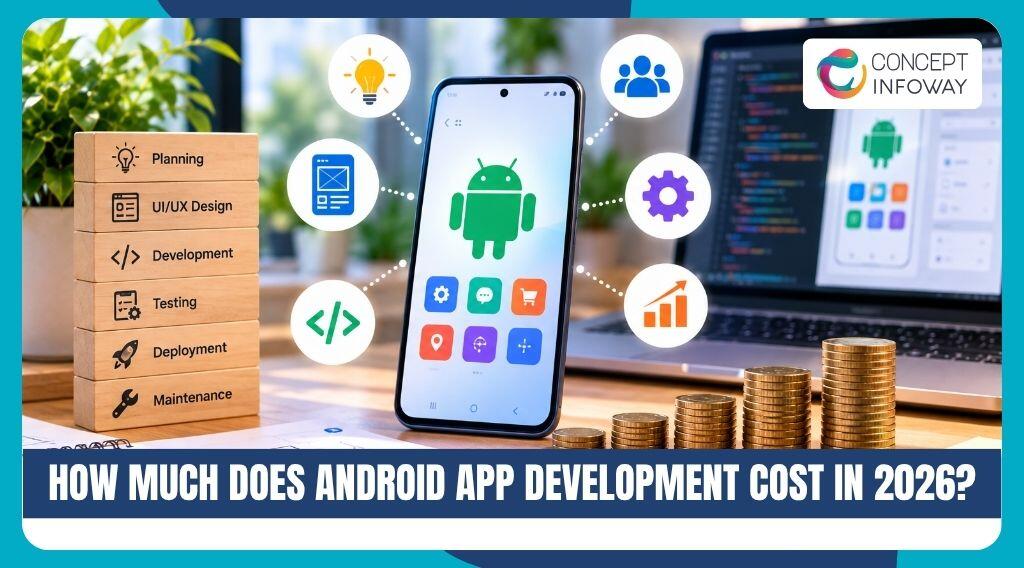
How Much Does Android App Development Cost in 2026?
Android app development cost can range from a relatively focused investment for a basic business app to a substantial budget for a secure, integrated platform with custom workflows.
The final figure depends less on the Android label itself and more on the product’s features, design, integrations, user roles, testing requirements, and long-term support needs.
For business owners and product teams planning an app in 2026, a useful estimate must do more than provide a single number.
This guide explains the cost ranges, major pricing factors, development approaches, overlooked expenses, and questions to ask an Android app development company in the USA before approving a proposal.
Android App Development Cost: Practical 2026 Estimates
The most useful way to estimate Android app development cost is to separate projects by complexity rather than rely on one universal price.
A calculator, internal workflow tool, customer portal, marketplace, and regulated-data application can all be called Android apps, but they require very different levels of planning and engineering.
These ranges are planning estimates, not fixed quotations. Actual app development cost varies by scope, technology choices, team structure, location, integrations, security requirements, and the condition of any existing product or codebase.
Typical Cost Ranges by App Complexity
A basic Android app with a small number of screens, straightforward navigation, standard forms, and limited server-side logic may often fall in the range of approximately $30,000 to $70,000.
This type of product might support a local service business, a simple booking workflow, a content experience, or a narrowly defined internal process. This is why Android app development cost depends on detailed requirements.
A mid-level custom app commonly requires user accounts, an administrative area, a backend, push notifications, payments, maps, reporting, or connections to existing business systems.
A reasonable planning range may be approximately $70,000 to $150,000, depending on how many of these elements are included and how deeply they interact.
A complex application can exceed $150,000 and may reach $500,000 or more when it includes multiple user roles, real-time functionality, sophisticated automation, large data volumes, advanced security, hardware connections, or several third-party systems.
Marketplace platforms, logistics products, financial workflows, healthcare-related applications, and enterprise tools frequently fall into this category. Clear scope makes Android app development cost easier to forecast.
The range is more useful when paired with a feature list.
For example, a customer app that only displays service information is fundamentally different from one that manages subscriptions, stores sensitive account data, synchronizes with a CRM, sends event-based notifications, and gives staff a real-time operations dashboard.
Why a Single Price Can Be Misleading
Two proposals with different totals may not be comparing the same product. One may include product discovery, UX research, backend development, automated testing, deployment support, and documentation.
Another may price only the visible Android screens and leave integrations, quality assurance, or post-launch fixes outside the estimate. That distinction matters when discussing Android app development cost.
Before comparing proposals, confirm whether each one includes the same scope. Ask whether the estimate covers design, project management, API work, admin tools, testing devices, release preparation, analytics, security review, source-code ownership, and maintenance.
A lower initial figure can become more expensive if essential work appears later as a change request.
Estimate Your Android App Budget with Professional Development Support!
Get A Free QuoteWhat Actually Drives Android App Development Cost?
Features matter, but the relationships between features usually matter even more. A screen that appears simple may require data rules, permissions, notifications, offline behavior, payment handling, or synchronization with another system. Evaluating these dependencies early produces a more realistic budget.
Product Scope and User Roles
The number of user types affects both the interface and the underlying logic. An app for one customer role may need only a straightforward account area. An app serving customers, employees, managers, vendors, and administrators must handle different permissions, dashboards, actions, and approval paths.
User roles also create testing combinations. Every important workflow should be checked for authorized and unauthorized actions, incomplete information, failed payments, expired sessions, and unusual account states.
That work is part of professional mobile app programming even when users never see it directly. Teams should include this item when estimating Android app development cost.
Integrations and Backend Requirements
An Android app rarely operates in isolation. It may need to connect with a payment provider, CRM, ERP, booking platform, inventory database, mapping service, identity provider, analytics system, or custom API.
Each integration can introduce authentication rules, data mapping, error handling, rate limits, vendor dependencies, and ongoing maintenance responsibilities. The decision belongs in any realistic Android app development cost budget.
Backend work can represent a significant portion of the budget. The server must store and process data, enforce permissions, communicate with the app, and remain reliable as usage grows.
If the business already has usable APIs, the project may move faster. If information is trapped in spreadsheets or disconnected systems, additional architecture and data work may be required.
Design, Performance, and Device Coverage
Custom mobile apps for business need more than attractive screens. The design should account for the user’s environment, such as poor connectivity, one-handed use, field work, large data sets, or time-sensitive tasks.
A product used by warehouse staff has different design priorities from a consumer shopping app. This can help keep Android app development cost expectations realistic.
Android also operates across many device sizes, operating-system versions, manufacturers, and hardware configurations. A defined device-support strategy helps control cost.
Supporting every possible device can increase testing effort, while supporting too narrow a range may exclude important customers or employees. This trade-off is part of responsible Android app development cost planning.
Security, Compliance, and Reliability
Security requirements should be considered during architecture, not added after development. User authentication, role permissions, secure data transmission, local storage, session handling, logging, backup procedures, and administrative controls all affect scope. It is another input in Android app development cost planning.
The applicable requirements depend on the information and industry involved. Businesses handling health, financial, employee, identity, or other sensitive information should obtain appropriate professional and legal guidance rather than assuming that a generic app template is sufficient.
Security work can increase upfront cost, but weak controls can create much greater operational and reputational risk.
Ready to Build Your Android App? Get Expert Development Services!
Get A Free QuoteHow Should You Choose an Android Development Approach?
The right development approach depends on the product’s goals, expected users, existing systems, internal resources, and long-term roadmap. The cheapest route at launch is not always the lowest-cost route over the life of the product.
Native Android Development
Native development is built specifically for Android and can provide strong access to platform capabilities, device features, and Android-specific performance controls.
It may be appropriate when the app depends heavily on device hardware, background behavior, advanced animations, or platform-specific functionality. These requirements can shift Android app development cost significantly.
The trade-off is that a business planning both Android and iOS may need separate implementation work unless it uses a shared strategy for part of the product.
The decision should be based on the required experience and roadmap, not on the assumption that one approach is automatically better.
Cross-Platform Development
Cross-platform frameworks can allow teams to share portions of the codebase across Android and other platforms. This may reduce duplicated implementation for products with similar workflows on multiple operating systems.
It can be useful for businesses seeking broad market coverage while managing a defined initial budget. This choice can raise or lower Android app development cost.
However, shared code does not eliminate all platform-specific work. Device behavior, permissions, notifications, performance issues, app-store requirements, and specialized hardware may still require separate attention. A development partner should explain where code is shared and where native work remains necessary.
Build, Improve, or Integrate?
Not every project should start with a completely new application. If the business already has an app, the better option may be a redesign, performance improvement, feature extension, backend replacement, or targeted modernization.
Reviewing the existing codebase, dependencies, documentation, analytics, and technical debt is essential before choosing. The scope should be documented before comparing Android app development cost.
A practical planning exercise is to separate requirements into three groups: essential for the first release, valuable after users validate the product, and useful but nonessential.
A focused first version should still solve a meaningful customer or operational problem. Removing low-value complexity can reduce risk without producing a product that feels incomplete.
At Concept Infoway, this type of scope discussion is relevant when a business is evaluating Android app development services rather than simply requesting screens.
The objective is to connect product priorities with a build plan that can be tested, measured, and extended responsibly. This factor can materially change Android app development cost.
The global Mobile App Development Market was valued at approximately USD 94.4 billion in 2024, according to Market Research Future. The market is expected to increase from USD 116.87 billion in 2025 to nearly USD 988.5 billion by 2035, reflecting significant growth in the mobile app development industry over the forecast period.
Which Ongoing Costs Should You Include?
The launch budget is only one part of the ownership model. Android app maintenance, infrastructure, third-party services, analytics, security work, and future improvements should be considered before development begins.
Planning these items early prevents the common mistake of treating launch as the end of the project.
Maintenance and Technical Upkeep
Maintenance may include operating-system compatibility updates, dependency updates, defect resolution, security improvements, performance monitoring, device testing, and adjustments when a connected service changes its API. The amount varies with the app’s age, architecture, integrations, usage, and release frequency.
A useful budget should distinguish corrective work from planned product development. Fixing a broken workflow is different from adding subscriptions, a loyalty program, or a new employee dashboard.
Both may be necessary, but they should not be treated as the same category. A reliable Android app development cost estimate should account for this work.
Infrastructure and Third-Party Services
Apps may rely on cloud hosting, databases, file storage, email or SMS providers, maps, payment processing, analytics, customer-support tools, identity services, and notification infrastructure.
Some vendors charge based on usage, while others use subscriptions or transaction fees. Pricing and terms can change, so these should be reviewed directly with the relevant provider.
The app itself may be inexpensive to download while the systems behind it carry ongoing costs.
A high-volume application with images, video, location tracking, or real-time updates can have a very different infrastructure profile from a small internal tool. This work can influence both initial and ongoing Android app development cost.
Analytics, Support, and Improvements
An app should provide enough measurement to answer practical questions: Where do users abandon onboarding? Which features are used? Are payments failing? Do employees complete tasks faster? Without reliable analytics and error reporting, teams may spend money improving assumptions rather than verified problems.
Support expectations also affect operations. Decide who handles user questions, account issues, failed transactions, release communication, and urgent defects. A maintenance plan that defines responsibilities and priorities is more useful than a vague promise of support.
A responsible proposal should identify assumptions, exclusions, dependencies, and likely change areas.
At Concept Infoway, businesses exploring Android app development services can use this discussion to distinguish a one-time build estimate from the broader cost of operating a dependable digital product. The requirement should be reflected in the Android app development cost estimate.
How Can You Compare Android App Development Companies in the USA?
Choosing a partner is a delivery and risk decision, not just a price comparison. The right Android app development company USA businesses select should be able to explain how requirements become working software, how decisions are documented, and how quality is checked before launch.
Questions to Ask Before Signing
Ask the prospective team to explain its discovery process, recommended release strategy, web design and development responsibilities, testing approach, communication rhythm, technical documentation, and post-launch support.
You should also understand who owns the source code, design files, accounts, data, and credentials when the engagement ends. The impact becomes clearer when Android app development cost is tied to scope.
Clarify how the team handles scope changes. A sound process does not pretend that requirements will never change. It explains how changes are assessed, prioritized, approved, and reflected in budget or schedule. This protects both sides from informal decisions that create confusion later.
How to Review a Proposal
A useful proposal should connect business outcomes to defined deliverables. Look for details about user roles, major workflows, backend components, integrations, supported devices, testing environments, analytics, deployment responsibilities, and known assumptions. It should be considered before finalizing Android app development cost.
Be careful with estimates that list only a number of screens. Screen count does not reveal the difficulty of data synchronization, permissions, business rules, offline behavior, or third-party connections.
Conversely, a long feature list does not prove that the team understands the customer’s actual operating model.
Signs of a Better-Fit Partner
The strongest early conversations usually include questions about users, existing processes, success measures, technical constraints, and future changes.
A partner should be willing to identify uncertainty instead of hiding it behind a precise figure that cannot yet be justified. It can also affect post-launch Android app development cost.
For a U.S.-focused business, communication, documentation, time-zone coordination, data handling expectations, and familiarity with business software integrations may matter as much as development technique.
Concept Infoway can be relevant for organizations assessing web, software, mobile app development company, and related digital needs together, particularly when the Android product must connect with an existing online business process.
Wrapping Up
Android app development cost in 2026 is shaped by product complexity, not by a single standard rate.
A focused app with limited workflows may require a very different investment from a secure, integrated platform with multiple user types, custom backend services, and ongoing operational demands.
Start by defining the business problem, the first-release users, the workflows that must work reliably, and the systems the app must connect to.
Then separate essential features from later improvements, choose an appropriate development approach, and evaluate proposals based on scope, quality controls, ownership, maintenance, and communication rather than price alone. This decision can influence the final Android app development cost.
The most useful estimate is one that makes assumptions visible and gives your team a practical path from idea to validated product.
If you are evaluating Android app development services, Concept Infoway can help you examine the product requirements, technical considerations, and broader digital environment before deciding how to proceed.
FAQs About Android App Development Cost in 2026
What is the average Android app development cost in 2026?
A basic Android app may cost about $30,000 to $70,000, while mid-level products may range from $70,000 to $150,000. Complex apps can range from $150,000 to $500,000 or more depending on scope.
What factors have the biggest effect on Android app development cost?
Features, user roles, backend complexity, integrations, security, design depth, device coverage, testing, and post-launch support usually have the greatest effect on app development cost.
Are Android app development services priced by the number of screens?
Screen count can help estimate design and interface work, but it is not enough by itself. Data rules, integrations, permissions, backend services, testing, and offline behavior can drive more effort.
Is native or cross-platform development more affordable for Android apps?
Cross-platform development may reduce duplicated work when Android and iOS share similar workflows. Native development may be more suitable for advanced Android features, hardware access, or platform-specific performance needs. A detailed brief gives Android app development cost estimates more context.
What ongoing costs should businesses budget for after an Android app launches?
Plan for Android app maintenance, hosting, databases, third-party services, security updates, device testing, analytics, support, defect fixes, and future feature development. Costs vary with usage and complexity.
How can I reduce Android app development cost without weakening the product?
Prioritize one valuable release, reuse reliable business systems where practical, define supported devices, validate workflows early, and postpone low-value features. Do not remove essential security, testing, or data protection.
What should I ask an Android app development company in the USA before hiring?
Ask about discovery, technical approach, testing, integrations, ownership, documentation, communication, change control, deployment, maintenance, and what the estimate excludes. Compare proposals using the same scope.
Can Concept Infoway help estimate custom mobile apps for business?
Concept Infoway can help businesses review app goals, workflows, integrations, and technical requirements when evaluating custom mobile apps for business. A responsible estimate depends on confirmed scope and assumptions.


What Is Generative Engine Optimization? A Complete Guide