






 Web Based Solutions


 Mobile App Development









 UI/UX Design

 Digital Marketing



 Quality Assurance



 Managed IT Services

 Web Developers












 Mobile App Developers




 Frontend Developers




 Open Source Developers








 Microsoft Certified Developers




 Cross Platform Developers


 Quality Assurance


 Microsoft
 Open Source
 JS Frameworks

 Business Models
 Intellectual Property Protection
 IT Consulting Services
 IT Outsourcing Services
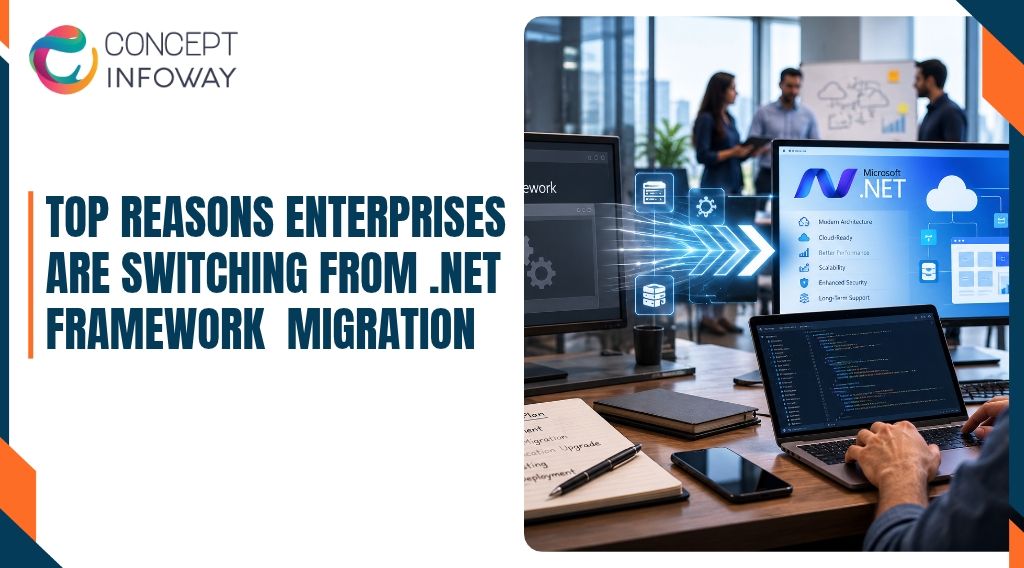
Top Reasons Enterprises Are Switching from .NET Framework Migration
.NET Framework migration is becoming a strategic priority for enterprises that need faster applications, stronger security practices, easier cloud adoption, and a technology foundation that can support future growth.
Many organizations are still operating business-critical systems built years ago, and replacing them all at once may be unrealistic, but continuing to delay modernization can make every future change more expensive and risky.
This article explains why enterprises are moving from the traditional .NET Framework to modern .NET and ASP.NET Core, how to decide whether migration is appropriate, which technical and operational issues require attention, and how a structured migration plan can reduce disruption.
It also explains where a .NET development partner such as Concept Infoway can support assessment, planning, development, testing, and post-migration improvement.
Why Enterprises Are Prioritizing .NET Framework Migration
A legacy application can continue to perform its core function while gradually becoming harder to secure, maintain, integrate, and scale. That difference between “it still works” and “it still supports the business efficiently” is often what triggers a modernization conversation.
Legacy Stability Can Hide Growing Business Risk
Enterprises rarely decide to migrate because an older application suddenly stops working. More often, the pressure accumulates. Developers spend more time understanding old dependencies, infrastructure teams manage aging deployment processes, and business teams wait longer for changes that should be routine.
The system may also depend on outdated libraries, tightly coupled modules, manual server configuration, or undocumented workarounds. Each dependency increases the effort required to make a change safely.
A small feature request can require regression testing across unrelated parts of the application because the original architecture does not provide clear boundaries. Accumulated constraints can establish the case for .NET Framework migration before an outage.
This creates a form of technical risk that may not appear in a standard financial report. It shows up as slower releases, delayed campaigns, difficult hiring, inconsistent environments, and increased dependence on a small number of developers who understand the system’s history.
Modernize Your Legacy Apps with Expert .NET Migration Services
Get A Free QuoteModernization Supports Broader Technology Goals
.NET Framework migration is usually part of a wider technology initiative rather than an isolated code conversion. Enterprises may be preparing to move workloads to cloud infrastructure, introduce automated deployment, improve observability, expose APIs, connect with new business systems, or provide a better experience across web and mobile channels.
Modern .NET and ASP.NET Core can support these goals through a more flexible application model, cross-platform deployment options, improved configuration patterns, and better alignment with current development and operations practices. The exact benefit depends on the application’s architecture, dependencies, hosting environment, and target design.
A .NET Framework migration should therefore be evaluated against business outcomes. If the business needs faster release cycles, more reliable integrations, or lower operational friction, the modernization plan should measure those goals instead of focusing only on the framework version.
The Cost of Waiting Is Not Always Obvious
Postponing migration may appear financially conservative because it avoids immediate project expenditure. However, delay can increase the cost of future work when the codebase grows, key dependencies become harder to replace, or the organization loses people with legacy platform experience.
Delaying .NET Framework migration can increase security review effort and reliance on old libraries.
Waiting can also force an enterprise into a rushed migration after a security concern, infrastructure change, acquisition, or major customer requirement. Planned modernization gives teams more control over sequencing, testing, and risk management. It does not remove complexity, but it allows the complexity to be handled deliberately.
How .NET Framework Migration Can Improve Application Performance
Performance is one of the most visible reasons enterprises investigate modernization, but a framework change alone does not automatically make every application faster. The strongest results usually come from combining the migration with architecture review, profiling, database optimization, deployment improvements, and user-focused testing.
Application Speed Depends on More Than the Runtime
Users experience an application as a complete system. Page rendering, API response time, database queries, network latency, third-party services, background jobs, caching, and front-end assets all influence perceived speed.
Before .NET Framework migration, an enterprise should establish a baseline rather than changing code without evidence. A website performance audit or application performance assessment can help identify whether the main constraints are related to the runtime, inefficient queries, oversized responses, synchronous processing, server configuration, or an overloaded integration.
Early .NET Framework migration testing should include database and network latency, not just execution speed.
Useful baseline measures may include:
- Initial page response time and key API latency
- Error rates, timeout frequency, and resource utilization
- Database query duration and the performance of high-volume transactions
- Core user journeys such as login, search, checkout, reporting, or account updates
These measurements make it easier to distinguish genuine improvement from a change that merely feels faster in a developer environment.
ASP.NET Core Can Support More Efficient Application Design
ASP.NET Core development services are often considered during migration because the platform supports modular middleware, dependency injection, modern configuration approaches, and flexible hosting models. These capabilities can make it easier to remove unnecessary processing and create clearer request pipelines.
The scope of .NET Framework migration depends on routing, middleware, hosting, and dependencies.
The performance benefit comes from how the application is redesigned and tuned. Teams may improve endpoint behavior, introduce asynchronous processing where appropriate, reduce repeated database calls, optimize serialization, use response caching, or separate background work from customer-facing requests.
For example, an enterprise reporting portal may previously generate a large report during a user’s browser request. A modernization project could move report generation to a background process, notify the user when the file is ready, and keep the main interface responsive.
That improvement is architectural, not simply the result of changing the framework.
Performance Must Be Tested Under Realistic Conditions
A modernized application can perform well during a developer test and still struggle when many users access it simultaneously. Load testing should reflect realistic traffic patterns, data volumes, permissions, integrations, and peak workflows. A .NET Framework migration must be tested with representative workloads and usage patterns.
Testing is especially important when the migration changes database drivers, authentication behavior, serialization, session handling, or external service communication. Performance comparisons should use equivalent scenarios before and after migration and should account for infrastructure differences.
After .NET Framework migration, enterprises should also monitor performance. Application speed can change as data grows, new features are introduced, or traffic patterns shift. Monitoring helps teams identify regressions before users report them and provides evidence for future optimization work.
The Business and Engineering Benefits of Moving to Modern .NET
A successful migration should create value for both the business and the teams responsible for operating the application. The most useful evaluation considers maintainability, delivery speed, infrastructure choices, security processes, integration needs, and long-term scalability together. Successful .NET Framework migration should improve delivery and system ownership, not merely runtime versions.
Better Support for Cloud and Deployment Strategies
Many enterprises are adopting cloud services, containers, automated deployments, or hybrid infrastructure. Modern .NET is designed to work across a broader range of hosting models, which can make these strategies easier to implement when the application is prepared correctly.
This does not mean every migrated system should immediately move to containers or a new cloud provider. A phased approach may be more appropriate. An enterprise might first modernize the application while keeping its existing hosting arrangement, then improve deployment automation, and later evaluate infrastructure changes based on operational evidence.
Review cloud assumptions during .NET Framework migration because deployment behavior may change.
Keeping application modernization and infrastructure transformation separate can reduce the number of variables in the project. In other situations, combining them may be justified if the existing environment is itself a major limitation. The right decision depends on risk, skills, compliance needs, operating costs, and business deadlines.
More Maintainable Code and Clearer Ownership
Migration projects provide an opportunity to examine code that has accumulated over years. Teams can identify duplicated logic, obsolete modules, unclear responsibilities, unused libraries, and interfaces that make testing difficult.
A well-planned migration does not require rewriting every component. Some stable modules may be retained temporarily, while high-risk or high-value areas are refactored first. Clear boundaries allow the enterprise to modernize incrementally rather than turning the project into an uncontrolled rewrite.
Clear module ownership makes .NET Framework migration easier to support after cutover.
Modern development practices can also improve ownership. Automated tests, source-controlled configuration, repeatable deployments, logging standards, and documented interfaces make it easier for more than one person to understand and support the system.
Easier Integration With New Business Systems
Enterprises frequently need to connect legacy applications with customer relationship platforms, payment services, analytics tools, identity providers, partner systems, and mobile applications. Older applications may support these integrations, but the process can require custom workarounds and careful manual handling.
A modernized application can provide a cleaner foundation for API development, authentication improvements, structured data exchange, and event-driven workflows where appropriate. That can reduce friction when the business adds a new channel or changes a supporting platform. Integration mapping helps .NET Framework migration avoid breaking downstream service contracts.
Integration design still requires caution. APIs expose business capabilities and data, so authorization, validation, rate controls, error handling, logging, and versioning should be part of the migration plan. Modern technology does not replace sound engineering discipline.
Improved Delivery for Business Teams
When .NET Framework migration makes a system easier to test and deploy, business teams may be able to receive improvements in smaller, more predictable releases. This can support faster experimentation, quicker responses to customer feedback, and less pressure to bundle unrelated changes into large releases.
The business benefit depends on process as well as technology. If deployment remains manual, testing remains incomplete, or requirements are not prioritized, the new framework will not solve the entire delivery problem. Migration should be paired with practical improvements in development workflow and release governance.
A .NET Framework migration plan should consider release cycles and business-user disruption.
Upgrade to Modern .NET for Better Performance and Scalability
Get A Free QuoteWhat Should Enterprises Evaluate Before Starting .NET Core Migration?
.NET Core migration is not a single procedure that works for every enterprise application. The safest approach begins with an assessment of the application, its dependencies, its users, and the business consequences of downtime or regression.
Application Architecture and Dependency Review
Start by documenting the current system. Review projects, libraries, database access, authentication, session state, file handling, scheduled jobs, reporting components, third-party controls, native dependencies, and integrations.
Pay particular attention to components that may not have a direct modern equivalent. A legacy reporting library, specialized hardware integration, or custom authentication module can affect the migration path more than the main application code. Dependency inventory is essential to .NET Framework migration when older libraries lack replacements.
A useful assessment should classify each component as suitable for direct migration, requiring adaptation, requiring replacement, or a candidate for retirement. This classification creates a practical scope instead of assuming that every line of code has the same value.
Business-Critical Workflows and Data Risk
Technical compatibility is only one part of the decision. Identify the workflows that cannot fail, such as order processing, payment capture, inventory updates, customer access, financial reporting, or regulatory record handling.
For each workflow, define how success will be tested and how the business will operate if the new version must be rolled back. Data migration, transaction integrity, duplicate processing, and reconciliation deserve particular attention.
A visually successful application can still cause serious problems if a transaction is recorded incorrectly or a background job runs twice. The .NET Framework migration test plan should validate critical transactions and data.
Use representative data and realistic permissions during testing. A migration tested only with small sample records may not reveal query problems, file-size limits, timeout behavior, or memory pressure that appear in production.
Security, Identity, and Configuration Changes
.NET Framework migration can expose differences in authentication, authorization, encryption, cookies, session management, secrets, and configuration behavior. These areas should be reviewed rather than assumed to work exactly as they did in the legacy environment.
Configuration should be separated from source code where appropriate, and sensitive values should be managed through secure operational practices.
Access should be reviewed using least-privilege principles, while logs should provide enough information for troubleshooting without exposing confidential data. Handle configuration and secrets carefully during .NET Framework migration as hosting models change.
Security testing should cover both the application and its deployment environment. A framework upgrade is valuable, but it should be part of a broader security review rather than treated as a complete security solution.
Migration, Rebuild, or Hybrid Approach?
Enterprises generally consider three broad paths. A direct migration changes the platform while preserving much of the existing behavior. A rebuild redesigns major portions of the application. A hybrid strategy modernizes selected services while the legacy system continues to operate.
A direct migration may reduce initial scope but can preserve architectural limitations. A rebuild may create a cleaner result but carries more requirements, design, testing, and delivery risk. A hybrid approach can reduce disruption, although it introduces temporary integration and operational complexity.
The right .NET Framework migration path may combine selective modernization with legacy support.
The best choice depends on business urgency, code quality, test coverage, dependency constraints, and the value of redesigning the user experience. A website performance audit and technical discovery process can help determine whether performance problems are caused by the framework, the architecture, or both.
The global web development market was valued at USD 80.60 billion in 2025 and is projected to grow from USD 87.75 billion in 2026 to USD 134.17 billion by 2031, registering a compound annual growth rate (CAGR) of 8.87% during the forecast period (2026–2031).
How to Plan a Lower-Risk Enterprise Migration
A migration becomes easier to control when the work is divided into measurable stages. The goal is not to eliminate every uncertainty before development begins; it is to discover the most important uncertainties early and create a safe path for resolving them.
Establish a Baseline and Define Success
Before implementation, record current performance, error rates, deployment steps, infrastructure dependencies, support volume, and the behavior of priority workflows. Define measurable acceptance criteria for the new version. Define baseline measures so .NET Framework migration outcomes can be evaluated after deployment.
Success may include maintaining functional parity for critical workflows, improving selected response-time targets, reducing deployment effort, increasing automated test coverage, or enabling a new hosting model. Avoid vague goals such as “make the system modern” because they make scope and completion difficult to evaluate.
Start With a Controlled Pilot
A .NET Framework migration pilot should represent real technical conditions without placing the highest-risk business process at the center of the first release. A self-contained module, read-heavy workflow, or internal portal may be a suitable starting point when its dependencies are understood.
The pilot should validate build processes, deployment, logging, monitoring, authentication, database connectivity, testing, and rollback. If those operational foundations are not working in a small release, expanding the migration will increase risk rather than solve it. A pilot makes .NET Framework migration risks more visible before important workflows move.
Modernize in Slices Rather Than One Large Rewrite
Incremental migration allows an enterprise to learn from each release. Teams can prioritize areas based on business value, user pain, operational risk, and technical dependency order.
A common sequence is to establish shared platform components, migrate a bounded feature area, run old and new paths in parallel where necessary, compare results, and then expand. The exact sequence should reflect the application. Some systems require database-first work, while others should begin with APIs or user-facing modules.
A staged .NET Framework migration must prevent conflicting rules between old and new systems.
Parallel operation requires clear ownership of data and business rules. If both systems can update the same records, synchronization and conflict handling must be designed explicitly. Otherwise, the temporary architecture can create more problems than the original system. For .NET Framework migration, parallel operation requires explicit data ownership and reconciliation.
Build Testing and Rollback Into the Plan
Regression testing should cover business behavior, not only whether pages load. Include calculations, permissions, notifications, integrations, scheduled jobs, exports, error handling, and unusual but valid data conditions.
Automated tests are especially valuable for workflows that must remain stable during repeated migration releases. Manual testing still matters for usability and operational scenarios, but automation provides faster feedback as code changes continue.
Every release should have a rollback or recovery plan appropriate to the application. The plan should identify what happens to new data, queued jobs, external transactions, and user sessions if the deployment must be reversed. Build rollback plans into .NET Framework migration releases before production cutover.
Choose a Partner That Understands the Business System
A .NET development company should be evaluated on more than its ability to write modern code. Ask how the team handles discovery, dependency analysis, test planning, deployment, security, documentation, communication, and post-release support.
Concept Infoway can be a relevant partner for enterprises evaluating .NET development, ASP.NET Core development services, application modernization, and related web technology needs.
The practical fit for .NET Framework migration should be assessed through the team’s understanding of the existing system, proposed migration stages, risk controls, and ability to connect technical work with business priorities.
For organizations looking for an ASP.NET Core development company in the USA, location and communication are useful considerations, but they should not replace technical due diligence.
Review the proposed approach, clarify responsibilities, confirm what is included in discovery and testing, and make sure the plan addresses the application’s actual constraints rather than presenting a generic rewrite. Choose .NET Framework migration support that can document dependencies and validate critical behavior.
Wrapping Up
Enterprises are pursuing .NET Framework migration because legacy applications can restrict performance, security planning, cloud adoption, integration, release speed, and long-term maintainability even when those applications still operate.
Moving to modern .NET or ASP.NET Core can create a stronger foundation, but the outcome depends on assessment, architecture decisions, testing, deployment discipline, and business-focused planning.
The most reliable approach starts with evidence. Establish a performance and operational baseline, map dependencies, identify critical workflows, compare migration and rebuild options, and begin with a controlled scope. Treat data integrity, identity, integrations, monitoring, and rollback as core project requirements rather than final-stage details.
If your organization is evaluating .NET Framework migration, Concept Infoway can help you explore the technical and business considerations involved in modernization. A focused discovery process can clarify whether migration, phased modernization, or a hybrid approach is the right next step for your application.
FAQs - .NET Framework Migration
What is .NET Framework Migration?
.NET Framework migration is the process of moving an application from the traditional Windows-based .NET Framework to modern .NET, often with ASP.NET Core, while preserving or improving its business functionality. The change can involve updating project files, replacing incompatible libraries, restructuring hosting, and revisiting authentication, data access, or Windows-specific components. It is rarely a simple version-number upgrade for a complex legacy system. Teams should inventory dependencies and business-critical functionality before estimating work. A successful plan defines how equivalent behavior will be verified and how users will be protected during deployment.
Why are enterprises moving from .NET Framework to modern .NET?
Enterprises typically migrate to improve maintainability, application speed, cloud and deployment flexibility, integration options, security practices, and the ability to support future development more efficiently. Modern .NET offers a more current development platform and wider deployment options, but the benefits depend on application architecture and organizational goals. A .NET Framework migration program should identify unsupported dependencies and constraints that make future changes expensive. It should also set measurable objectives for performance, maintenance, security, and delivery. Not every older system needs immediate replacement, so prioritize based on actual business risk.
How long does a .NET Framework Migration take?
The duration varies according to application size, code quality, dependencies, integrations, testing needs, and migration scope. A technical assessment is needed before establishing a realistic project plan. Start with a discovery period rather than assuming a standard timeline. .NET Framework migration estimates depend on custom code, third-party packages, framework-specific features, testing depth, infrastructure, and release constraints. Some work may be completed incrementally, while deeply coupled systems need more preparation. Establish milestones for dependency remediation, automated tests, integration verification, user acceptance, and rollback readiness before agreeing to a delivery schedule.
Will .NET Core migration automatically improve application performance?
Not automatically. Modern .NET can provide a stronger performance foundation, but results also depend on database queries, architecture, caching, infrastructure, integrations, and code optimization validated through testing. Runtime improvements do not eliminate slow queries, inefficient data access, overly complex requests, or excessive network calls. A .NET Framework migration should include a performance baseline and representative load tests before and after changes. Teams can then separate gains from the platform itself from gains created by architectural redesign. Success means key workflows meet agreed targets with stable functionality, not that a benchmark improves in isolation.
Should an enterprise migrate, rebuild, or use a hybrid approach?
A direct migration may suit stable applications with manageable dependencies, while a rebuild may fit systems needing major redesign. A hybrid approach can reduce disruption when modernization must happen incrementally. The decision depends on the condition of the existing code, the availability of compatible libraries, release risks, and the intended future of the application. A .NET Framework migration can retain working functionality while modernizing selected components, whereas a rebuild changes more assumptions at once. A hybrid strategy may let services move in phases. Compare cost, integration needs, operational continuity, and testability before choosing a route.
What should a website performance audit examine before migration?
It should examine page and API response times, database queries, error rates, resource use, third-party services, traffic patterns, and critical user journeys to identify the true sources of application speed problems. Measure how the current application behaves under normal and peak demand, including database response, application errors, server resources, and dependencies. For a .NET Framework migration, capture comparable baselines so performance changes can be attributed to specific modifications. Examine API endpoints and business-critical transactions alongside web pages. Monitoring should also detect regressions after deployment, especially where infrastructure or authentication behavior has changed.
How can ASP.NET Core development services support enterprise modernization?
ASP.NET Core development services can support architecture planning, API development, application modernization, performance work, testing, deployment improvements, and integration with current business systems. A modernization partner can map legacy dependencies, recommend target architecture, update APIs, design tests, and improve deployment pipelines. .NET Framework migration should preserve data integrity and expected behavior while permitting changes where they deliver clear value. Ask how developers will deal with unsupported components and verify that replacement services meet requirements. A phased roadmap with accountable owners generally provides more control than an undefined wholesale rewrite.
How do I choose an ASP.NET Core development company in the USA?
Evaluate technical discovery, migration experience, dependency analysis, testing, security, communication, documentation, deployment planning, and post-launch support rather than choosing solely by location or stated technology expertise. Assess the provider’s ability to diagnose legacy systems before discussing the preferred new stack. A .NET Framework migration requires dependency mapping, integration knowledge, automated and manual testing, deployment planning, security review, and realistic handover documentation. Request clarity about responsibilities for infrastructure and continued support. Concept Infoway can be evaluated for its development and modernization capabilities in the context of the application’s actual constraints.


The Ultimate Guide to WordPress Maintenance Checklist in 2027