





 Web Based Solutions


 Mobile App Development


 UI/UX Design

 Digital Marketing


 Quality Assurance



 Managed IT Services

 Web Developers


 Mobile App Developers


 Frontend Developers



 Open Source Developers


 Microsoft Certified Developers




 Cross Platform Developers


 Quality Assurance


 Microsoft
 Open Source
 JS Frameworks

 Business Models
 Intellectual Property Protection
 IT Consulting Services
 IT Outsourcing Services
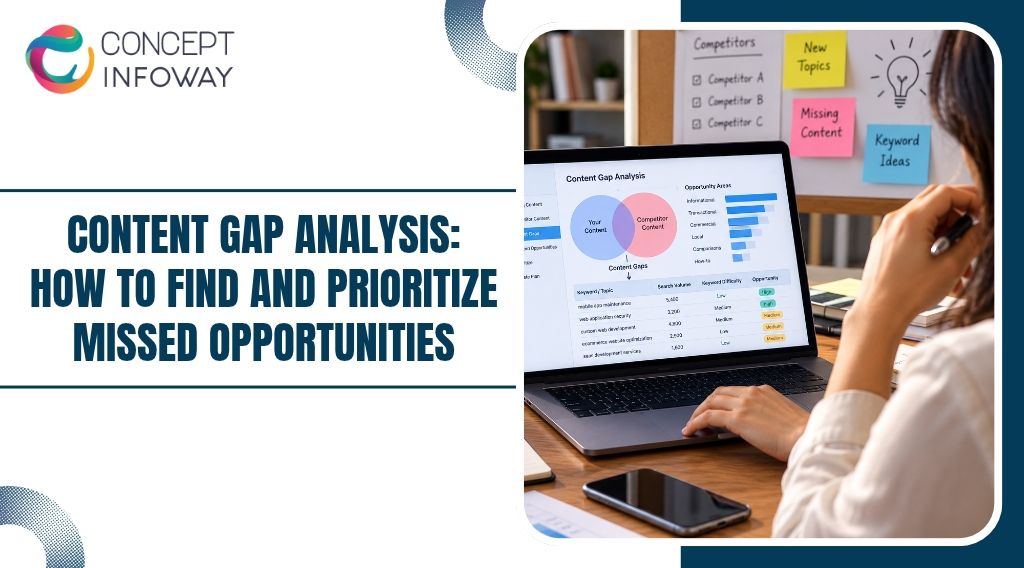
Content Gap Analysis: How to Find and Prioritize Missed Opportunities
Content gap analysis helps you find the topics, questions, and search opportunities your website is missing before you spend more time or budget creating content.
Without this process, teams often publish articles that overlap with existing pages, target keywords with little business value, or fail to address the comparisons and concerns that influence a buyer’s decision.
A useful analysis goes beyond copying a competitor’s keyword list. It connects search demand with your audience, existing content, technical SEO service needs, conversion goals, and competitive positioning.
This guide explains how to identify content gaps, how to separate meaningful opportunities from low-value keywords, and how to turn your findings into a prioritized SEO plan.
What Is Content Gap Analysis and Why Does It Matter?
The method involves comparing your website’s content with the information your target audience searches for and the content competing websites use to earn visibility. The objective is not to publish more pages simply because competitors have them.
The objective is to identify useful, relevant coverage that can improve organic visibility and help potential customers move closer to a decision.
A gap can exist at several levels. Your site may be missing an entire topic, an important subtopic, a comparison page, a location-specific explanation, or a clear answer to a question that appears repeatedly during the buying process.
Content gap analysis may also reveal that the right subject sits on the wrong page, with weak internal links, unclear search intent, or technical barriers that prevent search engines from understanding or indexing it properly.
The Main Types of Content Gaps
A keyword gap occurs when competing pages rank for relevant search terms that your website does not target effectively. For example, a digital marketing services company may rank for web design terms but have no useful page addressing website migration, ecommerce performance, or technical SEO service selection.
Keyword gap analysis can reveal these missing themes, but keywords should be treated as evidence of demand rather than a publishing checklist. Content gap analysis should distinguish missing topics from thin coverage of existing subjects.
A topic gap exists when your website does not adequately explain an important subject. A page may mention search engine optimization but fail to explain audits, content planning, local visibility, reporting, or technical improvements.
Topic gaps are especially important for readers who need enough information to trust a provider before contacting one.
A format or journey gap appears when the site has informational articles but lacks content for evaluation and action. A visitor may find a basic definition yet have no comparison guide, service page, implementation checklist, case-based explanation, or consultation pathway.
Strong SEO programs account for the entire journey from initial research to qualified inquiry. Mapping each buying stage makes content gap analysis useful beyond isolated keyword targets.
There are also quality and experience gaps. Your page may technically cover a subject but still be less helpful because it is outdated, too generic, difficult to scan, poorly organized, or disconnected from real business decisions.
In practice, these gaps often provide better improvement opportunities than simply finding another keyword variation.
Why More Content Is Not Always the Answer
Publishing too many pages can create overlapping URLs that compete with one another. It can also make a site harder to maintain, dilute internal links, and force search engines to choose between similar pages.
Before creating something new, determine whether the opportunity belongs on an existing page, in a new supporting article, or in a broader restructuring of the site. Effective content gap analysis first checks whether an existing page can meet the need.
For example, suppose a company has three articles about choosing an SEO provider. If each targets similar language but serves the same intent, creating a fourth article may increase confusion rather than visibility.
Consolidating the strongest information, improving the page’s structure, and redirecting or revising weaker URLs may be the better answer.
This method therefore supports both creation and restraint. It helps you decide what to add, what to improve, what to combine, and what not to pursue.
Find Content Gaps and Improve SEO Performance
Get A Free QuoteHow to Do a Content Gap Analysis Step by Step
A dependable process starts with business context and ends with a documented action plan. Tools can speed up data collection, but they cannot decide whether a keyword fits your products, customers, geography, or sales process. The following workflow combines research, judgment, and technical review.
Define the Business and Audience Before Collecting Keywords
Start by documenting the services or products you want to grow, the customers most likely to buy them, and the locations you serve. A keyword that produces traffic but attracts students, job seekers, or unrelated audiences may not deserve priority.
A lower-volume phrase with strong commercial intent may be far more valuable. Business relevance should guide content gap analysis even when search volume is modest.
Content gap analysis should also draw on the questions your sales team hears repeatedly. Ask which objections delay decisions, which services require the most explanation, and which customers arrive with unrealistic expectations. These conversations often reveal content opportunities that third-party SEO platforms cannot show clearly.
For a business evaluating search engine optimization companies in USA markets, the research should also account for location and audience language. A national service page may need supporting content for specific markets, industries, or business sizes, but location pages should not be created merely by changing a city name.
Each page needs a genuine reason to exist and useful local context. For location-specific pages, content gap analysis should verify genuinely distinct local intent.
Create a Reliable Content and Competitor Inventory
Export your important URLs and record each page’s topic, search intent, target audience, primary keyword, business purpose, organic performance, conversions, and last meaningful update. Include service pages, location pages, product pages, blog posts, resource pages, and high-value landing pages.
Then select competitors based on search results, not only on companies you compete with offline. A website may be a business competitor, a content competitor, or both. Review the domains that consistently appear for the queries that matter to your business.
A large publisher may provide useful topic evidence even though it is not a realistic commercial competitor. Content gap analysis improves when competitors are selected for comparable audiences and offerings.
A simple inventory can include these fields:
- URL and page type
- Main topic, search intent, and target audience
- Organic visibility, conversions, and content freshness
- Related pages, internal links, and technical concerns
- Recommended action: create, improve, consolidate, or leave unchanged
Do not rely on one data source. Search results, analytics, search performance data, customer feedback, sales notes, and a manual review each reveal different parts of the gap.
Collect Competing Topics and Queries
Use competitor keyword analysis to identify terms for which relevant competing pages receive visibility while your site has no comparable result. Compare several competitors rather than copying one domain.
One competitor may have a strong blog, another may have better service pages, and a third may perform well because of authority rather than content quality. Use content gap analysis to compare page types, not merely count competing URLs.
Look for patterns across the set. Repeated themes are more persuasive than isolated keywords. Pay attention to related questions, modifiers such as cost or comparison, industry-specific language, and phrases that indicate urgency or readiness to contact a provider.
A content gap tool can make this stage faster by comparing ranking keywords, URLs, estimated traffic, and topic clusters. Treat the output as a discovery list. Search volume and estimated traffic can be imperfect, especially for local, emerging, or highly specific queries.
Confirm the opportunity by examining the actual search results and asking whether the query represents a customer you want. Search results help confirm whether a content gap analysis finding reflects genuine intent.
Map Each Opportunity to Search Intent
In content gap analysis, classify each gap as informational, navigational, commercial investigation, or transactional. Then inspect the current results to understand what searchers appear to expect. If the results are mostly service pages, a long educational article may not be the strongest format.
If the results are detailed guides, a thin sales page may struggle to satisfy the query.
Intent can also change as the query becomes more specific. Someone searching for SEO basics may need education. Someone searching for a technical SEO service for a Shopify store may be comparing providers and looking for evidence of process, scope, and fit.
The page should answer the question at the level of commitment implied by the query. That intent check turns content gap analysis into a plan for meeting reader expectations.
Check Whether the Gap Is Truly New
Before assigning a new page, search your own website and inspect related URLs. Determine whether an existing page can be expanded without losing its original purpose. Check for keyword cannibalization, weak internal linking, indexation problems, duplicate content, outdated information, and pages that rank for the wrong intent.
This is where SEO gap analysis becomes broader than competitor research. A missing topic is only one type of gap. Slow templates, blocked crawlers, poor mobile usability, broken internal links, unclear canonical signals, or weak structured page organization may prevent existing content from performing.
Content improvements should not be expected to solve a technical problem that has not been diagnosed. Content gap analysis should identify technical barriers that can conceal useful existing coverage.
How to Prioritize Content Gaps for Business Impact
A long opportunity list is not a strategy. Prioritization determines which work receives resources first and prevents teams from treating every keyword as equally valuable. The strongest plans balance audience relevance, business value, achievable visibility, content effort, and technical readiness.
Score Relevance, Value, and Feasibility
Create a scoring model that reflects your business rather than adopting a generic formula without review. A practical model can rate each opportunity from low to high across five factors: audience relevance, commercial value, search demand, realistic competitiveness, and implementation effort.
In content gap analysis, a topic should score highly on relevance when it directly relates to a service, product, or problem your business is equipped to solve.
Commercial value rises when the query indicates evaluation or purchase intent, supports a profitable offering, or addresses a question that frequently affects sales conversations.
Feasibility improves when your site has relevant authority, supporting content, a suitable page type, and the expertise needed to produce a genuinely useful result. Feasibility scoring keeps content gap analysis grounded in the site’s capacity to compete.
Estimated search volume matters, but it should not dominate the decision. A broad term can bring visitors who never become customers, while a specific service query may produce fewer visits but stronger leads. Review performance by qualified traffic and assisted conversions when that data is available, not just by sessions.
Separate Quick Improvements From Strategic Builds
Some gaps can be closed by improving an existing page. Adding a missing section, clarifying the title and headings, answering a common objection, strengthening internal links, or updating stale information may produce more value than starting from zero.
Other opportunities need a new asset, such as a service page, comparison guide, industry landing page, implementation checklist, or supporting article. Strategic builds may take more effort, but they can establish a topic cluster and support several related pages over time.
For content gap analysis, separate modest updates from topics requiring dedicated production.
A useful prioritization view looks like this:
| Opportunity type | Typical action | Main risk if ignored |
| Missing high-intent service topic | Create or improve a focused landing page | Qualified visitors may choose a clearer provider |
| Important subtopic missing from a strong page | Expand and restructure the page | The page may appear incomplete or fail follow-up questions |
| Several overlapping articles | Consolidate, redirect, or differentiate | Internal competition and diluted authority |
| Content blocked by technical problems | Resolve technical SEO issues first | New content may remain difficult to crawl or index |
| Low-value competitor topic | Defer or reject | Resources are spent on traffic with little business value |
Consider the Full Conversion Path
An opportunity identified through content gap analysis becomes more valuable when it supports a measurable step after the visit. That step might be a consultation request, service inquiry, product comparison, email signup, phone call, or deeper visit to a relevant page.
Not every informational article needs a hard sales pitch, but it should help the reader move forward naturally.
For example, an article explaining how to evaluate a technical SEO service can link readers to a relevant service overview or a clear contact path. A guide about ecommerce SEO may help a reader identify problems before they request an audit.
The content should create confidence without promising a specific ranking, traffic increase, or timeline. Effective content gap analysis supports conversions without inflating expectations about search outcomes.
Revisit Priorities as Evidence Changes
Priorities are not permanent. Search results change, competitors publish new material, services evolve, and your own performance data becomes more useful. Review important gaps after publishing and allow enough time for meaningful measurement, while checking technical indexing and engagement issues earlier.
If a page receives impressions but few clicks, investigate the result presentation, intent match, and title before assuming the topic failed. If it receives visits but no qualified actions, examine audience fit, page experience, offer clarity, and the next step. Measurement should guide refinement rather than trigger automatic content production.
Use fresh rankings and customer questions to keep content gap analysis priorities current.
Unlock Content Opportunities and Grow Organic Traffic
Get A Free QuoteTurning a Content Gap Analysis Into an SEO Content Plan
The analysis becomes useful only when it produces work that someone can execute and evaluate. Convert each approved opportunity into a brief that explains the audience, intent, business purpose, content type, evidence, required expertise, internal links, and success measures.
Build Topic Clusters Without Forcing Them
Group related opportunities around a meaningful core topic. A central service page may be supported by articles addressing process, costs, comparisons, common problems, implementation considerations, and industry-specific needs. The relationship should be useful to readers, not created merely to place internal links.
A cluster for a technical SEO service, for instance, might include crawlability, indexation, Core Web Vitals, structured data, JavaScript rendering, and technical audit planning. These subjects are related, but they should not all be forced into one enormous page.
Give each topic its own page when it has distinct intent and enough practical value. Page-level intent matters in content gap analysis because overlapping pages may compete.
Write Briefs That Prevent Thin or Repetitive Content
A strong brief should state what the reader needs to decide or accomplish, not just list keywords. Include the primary question, related questions, evidence to verify, examples to use, misconceptions to correct, and the page’s recommended next step.
Specify what the new page must do differently from current results. It might provide a clearer process, explain trade-offs, show implementation considerations, address a neglected audience, or connect strategy with technical execution. This distinction prevents content that is merely longer than competing pages but not more useful.
Writers and subject-matter specialists should also agree on claims that require verification. Service scope, platform behavior, search features, regulations, and third-party tools can change.
Careful review protects trust and reduces the risk of publishing confident but outdated advice. Subject-matter review strengthens content gap analysis by preventing briefs from promising unsupported outcomes.
Improve Existing Pages Before Adding More URLs
Content gap analysis should start with pages that already have impressions, backlinks, relevant rankings, or conversion value. These pages may need stronger introductions, better information architecture, clearer examples, updated screenshots, improved calls to action, or additional internal links. Preserve useful sections while removing repetition and addressing the actual gap.
Consolidation can be appropriate when several URLs answer the same question. Compare their performance, backlinks, intent, and content quality before choosing a primary page. Redirects, canonicals, navigation changes, and indexation decisions should be handled carefully, especially on large or revenue-generating websites.
Include Technical Validation in the Publishing Process
Content cannot perform reliably if search engines cannot access, interpret, or index the page. Before and after publishing, check the URL’s status, canonical setup, internal links, mobile presentation, page speed considerations, structured data where appropriate, and whether the content is discoverable through the site’s information architecture.
During content gap analysis, verify crawlability and indexing before committing to production.
Technical review is not a substitute for useful content, and useful content is not a substitute for technical health. Concept Infoway can support businesses that need to connect SEO planning with website development, optimization, WordPress, Shopify, Laravel, or broader web solutions, provided the work matches the site’s actual requirements.
The practical goal is a site where valuable content can be found, understood, and acted on.
Measure Outcomes That Match the Original Goal
Set a baseline before publishing. Depending on the page’s purpose, monitor impressions, clicks, rankings, qualified organic visits, engagement, assisted conversions, direct inquiries, and movement through related pages. Avoid judging every page by the same metric. Track results against goals so content gap analysis becomes an ongoing improvement process.
A top-of-funnel guide may succeed by introducing a qualified audience and supporting later conversions. A service page should usually be assessed more closely for commercial engagement and inquiry quality.
If the goal was to recover visibility for an existing page, compare the relevant query group before and after the work rather than relying on an overall site average.
The global Search Engine Optimization services market was valued at USD 83.98 billion in 2026 and is projected to grow from USD 94.16 billion in 2027 to USD 164.3 billion by 2032, registering a compound annual growth rate (CAGR) of 11.78% during the forecast period (2027–2032).
What Should You Avoid When Performing Content Gap Analysis?
The process can create poor outcomes when teams confuse competitor imitation with strategy. The most common mistakes are not caused by a lack of tools; they come from skipping judgment, context, and follow-through.
Copying Competitor Coverage Without Checking Fit
A competitor may rank for a topic because it serves a different audience, has a different business model, or has years of authority behind it. Publishing a similar page does not reproduce those conditions.
Ask whether the subject is relevant to your customers and whether your organization can add original, accurate value.
In content gap analysis, competitor research should reveal questions and expectations, not supply text to rewrite. Review the search results, understand the intent, and develop a stronger answer through clearer explanation, better structure, useful examples, or more appropriate guidance.
Treating Search Volume as the Business Case
Search volume estimates can be useful for comparison, but they do not reveal lead quality, competitive difficulty, geographic fit, or conversion potential. They also may combine several intents under one broad phrase. Balance demand with business relevance and the likelihood that the visitor needs your solution.
Commercial relevance matters more than raw search volume when conducting content gap analysis.
For a specialized provider, a narrow query can be strategically important even if an SEO platform reports limited volume. Confirm the opportunity using search performance data, sales conversations, paid search observations where available, and direct knowledge of the market.
Publishing Pages That Overlap
Keyword variations often tempt teams to create separate pages for every phrasing. That approach can produce thin pages with nearly identical information. Decide whether searchers want distinct answers or one comprehensive resource.
If two pages serve different audiences or intents, make the difference obvious in their titles, structure, examples, and calls to action. If they do not, consolidate or improve the strongest page instead of creating another URL. Content gap analysis should document distinct reader intents before recommending similar pages.
Ignoring Technical and Experience Problems
A content gap may appear to be a writing problem when the actual issue is poor navigation, a noindex directive, an incorrect canonical, broken links, slow page templates, weak mobile usability, or an architecture that hides important pages.
A technical SEO service can help identify these conditions, but the review should be connected to business priorities rather than treated as an isolated audit.
Also inspect the page as a human visitor. Can someone understand the offer quickly? Are important answers easy to find? Does the design support reading on a phone? Is the next step clear without being aggressive? Search visibility is valuable only when the resulting experience earns trust.
Technical SEO reviews complement content gap analysis by explaining why existing pages underperform.
Failing to Refresh the Analysis
A gap analysis is a working decision tool, not a document to file away. Search behavior, competitor coverage, products, services, and customer questions change. Schedule reviews around major business or site changes and use performance data to update priorities.
At Concept Infoway, a practical SEO engagement should connect research with implementation, measurement, and ongoing refinement. Whether a business needs content planning, competitor keyword analysis, technical review, website optimization, or broader digital support, the appropriate scope depends on the site’s current condition and growth goals.
Wrapping Up
Content gap analysis helps turn SEO from a list of publishing ideas into a structured method for finding missed opportunities and deciding what deserves attention first. The strongest process combines competitor keyword analysis, customer insight, search intent, page quality, technical review, and business value.
Content gap analysis starts with understanding the audience and inventorying what already exists. Then compare relevant competitors, validate each gap, score the opportunity, and choose between improving, consolidating, creating, or deferring content. Keep technical SEO service considerations in the plan so valuable pages can be crawled, understood, and used effectively.
If your team has a large backlog or cannot determine why existing content is underperforming, Concept Infoway can help connect SEO research with web development, optimization, and digital marketing needs.
A well-prioritized plan should leave you with more than keywords: it should show which audience problem to solve, which page should solve it, and how that work supports a realistic business objective. A strong plan also identifies an owner and next action for each priority.
FAQs - Content Gap Analysis
What is Content Gap Analysis in SEO?
Content gap analysis compares your site with audience needs and relevant competitors to find missing or weak topics, questions, formats, and pages that could improve visibility and support business goals. The method should review existing URLs, search intent, audience questions, and content formats alongside competitor visibility. Content gap analysis is not just an exercise in finding unused phrases; it tests whether your site already answers a need and whether that answer is easy to find. The output should specify the likely value of each missed opportunity, the page that will address it, and who will verify quality before publication.
How do you do a Content Gap Analysis?
Inventory existing pages, define target audiences, review competitor coverage, collect relevant queries, map search intent, check technical issues, and prioritize opportunities by relevance, value, difficulty, and effort. Start by setting boundaries: which services, audiences, and search intents matter to the business? Use content gap analysis to compare a reliable inventory against competing results, then separate missing coverage from weak existing coverage. Check indexing and page overlap before planning new URLs. Rank opportunities by commercial relevance, realistic difficulty, production effort, and the action visitors should take after reading.
What is the difference between Content Gap Analysis and keyword gap analysis?
Keyword gap analysis focuses on search terms competitors rank for that you do not. Content gap analysis is broader and also evaluates topics, intent, page quality, formats, customer questions, and technical barriers. Keyword tools can surface terms, but similar terms may belong to a single page or represent different stages of a decision. Content gap analysis interprets those distinctions and examines whether content matches the depth expected by searchers. It can identify a missing explanation, an underdeveloped service page, or technical barriers that prevent existing pages from being discovered. Treat term counts as supporting evidence, not the final strategy.
Can a content gap tool replace an SEO specialist?
No. A content gap tool can identify competing keywords and URLs, but it cannot reliably judge audience fit, business value, intent, content quality, or whether a new page should replace an existing one. Automated comparisons are useful for collecting search queries and competing URLs at scale. Content gap analysis still requires human evaluation of intent, accuracy, subject-matter depth, feasibility, and how a page would support a conversion. A tool can flag a difference without knowing whether the audience is valuable or whether another page would create overlap. Use software for discovery, then review recommendations before committing resources.
How often should a business perform a Content Gap Analysis?
Review major gaps at least annually and after important service, market, competitor, or website changes. High-priority pages deserve more frequent performance checks and refinement based on search and conversion data. The cadence should reflect the pace of your content program and shifts in search results rather than a fixed monthly ritual. Content gap analysis benefits from checks of newly published pages, changes in competing coverage, and questions received by sales or support teams. Reprioritize after important business or website changes, and use performance data to decide whether a page needs revision, expansion, consolidation, or more time to mature.
How do I prioritize content gaps with limited resources?
Start with gaps tied to valuable services, strong customer demand, realistic ranking potential, and clear conversion paths. Improve existing high-potential pages before creating many new URLs. A shortlist is more useful than a large unranked export. During content gap analysis, score each opportunity for relevance to a service, likelihood of meeting reader intent, expected business value, and the resources needed to produce reliable content. Give existing pages the first look because a focused improvement may be easier to maintain than another URL. Document why each topic matters and what result will demonstrate its value.
Does Content Gap Analysis include technical SEO issues?
It can and should identify technical barriers such as indexing, internal linking, mobile experience, canonical, or crawlability problems. These issues may need a separate technical SEO service for proper resolution. Technical issues can make a topic appear absent from search even when a strong page exists. Content gap analysis should flag crawl restrictions, indexability problems, canonical conflicts, poor internal links, and broken mobile experiences for investigation. It does not replace technical diagnosis, but it can prevent teams from producing duplicate content to solve a visibility problem. Resolve likely barriers before concluding that a new page is necessary.
Can Concept Infoway help with Content Gap Analysis and SEO implementation?
Concept Infoway can help connect SEO research with content planning, website optimization, technical review, development, and digital marketing. The appropriate scope depends on your site, goals, platform, and existing performance. A useful engagement should connect research to practical publishing decisions instead of delivering only a spreadsheet of keywords. Content gap analysis can inform page planning, upgrades to existing content, internal linking, and technical priorities, with implementation scoped to the site’s needs. Concept Infoway can help align these workstreams, while the business retains visibility into proposed pages, owners, trade-offs, and measures of progress.

10 Reasons Why Mobile App Maintenance Is Essential for Business Growth