







 Web Based Solutions


 Mobile App Development








 UI/UX Design
 Digital Marketing



 Quality Assurance


 Managed IT Services
 Web Developers











 Mobile App Developers



 Frontend Developers



 Open Source Developers







 Microsoft Certified Developers



 Cross Platform Developers

 Quality Assurance

 Microsoft
 Open Source
 JS Frameworks
 Business Models
 Intellectual Property Protection
 IT Consulting Services
 IT Outsourcing Services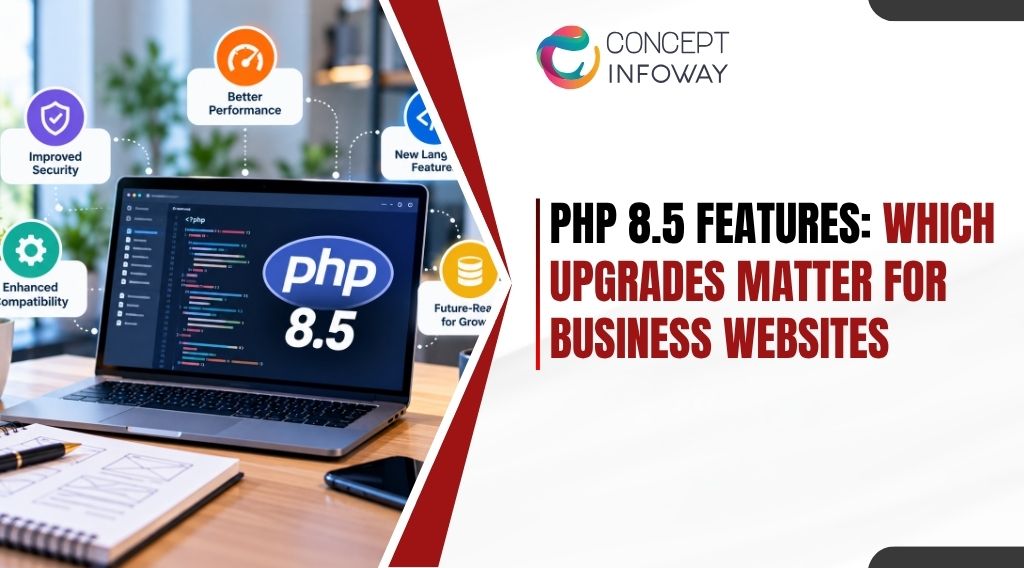
PHP 8.5 Features: Which Upgrades Matter for Business Websites
PHP 8.5 features can help your business website become easier to maintain, safer to operate, and more prepared for future development—but upgrading without checking your framework, extensions, integrations, and deployment process can create avoidable problems.
The most useful way to evaluate PHP 8.5 is not to ask whether every new feature is impressive; ask which changes support your business goals.
This guide explains the upgrades that matter most, where application speed and PHP security fit into the decision, and how to assess an upgrade with a PHP development partner such as Concept Infoway.
What the PHP 8.5 Features Mean for Business Websites
A PHP release affects more than the code running on your server. It also influences which frameworks and libraries you can use, how easily developers can maintain the application, whether hosting supports the environment, and how confidently your team can apply future security updates.
PHP 8.5 introduces language improvements and standard-library additions that can make common development tasks clearer. Some changes may be valuable immediately in a new application.
Others are mainly useful when a team is refactoring existing code. The business impact therefore depends on your website’s architecture, traffic patterns, integrations, and development roadmap. Existing architecture can determine which PHP 8.5 features matter most.
A Release Should Be Evaluated by Business Impact
A sensible review starts with four questions:
- Does the upgrade reduce a current maintenance or compatibility risk?
- Does it support a feature, integration, or development workflow your business needs?
- Can your team test and deploy it without putting customer transactions or lead generation at risk?
- Will the change improve the application over time, even if users do not notice an immediate difference?
For example, a company with a custom ordering portal may gain more from clearer object updates and improved URI handling than from adopting every new syntax feature.
A marketing website with an older content management system may need compatibility work before it can benefit from PHP 8.5 at all. Supported dependencies are important when adopting PHP 8.5 features.
This distinction matters because a runtime upgrade is not automatically a modernization project. Sometimes the correct first step is a compatibility audit.
In other cases, the upgrade belongs inside a larger plan involving framework updates, dependency replacement, database optimization, or a redesigned deployment process. These PHP 8.5 features should be evaluated with maintenance in mind.
The Upgrade Is More Than a Version Number
A PHP application normally depends on several connected layers: the PHP runtime, a framework or content management system, Composer packages, PHP extensions, database drivers, web-server configuration, scheduled jobs, payment or CRM integrations, and deployment tools.
One outdated dependency can prevent an otherwise healthy application from running correctly on a newer version.
This is why a production upgrade should begin with an inventory rather than a server change. The inventory should identify the current PHP version, framework version, installed extensions, third-party packages, custom code, background processes, and external services.
It should also record how the application is tested, deployed, backed up, and rolled back. Developers should document where PHP 8.5 features change existing behavior.
For a business website, the practical goal is continuity. Contact forms, account access, checkout, subscriptions, dashboards, and integrations must be tested—not just the home page.
Concept Infoway’s PHP development work can be relevant when a business needs this type of application review alongside custom PHP development, maintenance, or a broader web development project.
Looking to Adopt the Latest PHP Features? Get Our Expert Today!
Get A Free QuoteThe PHP 8.5 Features Most Likely to Help Business Applications
The most meaningful PHP 8.5 features for businesses are the ones that improve consistency, readability, and the ability to build or maintain reliable applications.
They do not all have equal value for every project, so the right approach is to match each capability to a real development need.
URI Handling for More Consistent Web Integrations
Business websites frequently work with URLs and URIs beyond simple page links. They may connect to payment gateways, marketing platforms, shipping tools, customer relationship management systems, analytics services, and internal APIs. Those addresses can include paths, query parameters, fragments, encoded values, and changing identifiers.
PHP 8.5 includes a dedicated URI extension designed to provide structured tools for working with URI values.
In practical terms, this can make code that creates, reads, modifies, and validates web addresses more consistent than relying on scattered string operations. A controlled upgrade lets teams validate PHP 8.5 features properly.
That matters when an application builds callback URLs, changes query parameters, processes webhook addresses, or passes links between services. Clearer URI handling can reduce mistakes such as incorrectly encoded values or accidentally discarded parameters.
It does not replace security validation, allowlist rules, or careful handling of untrusted input, but it can give developers a better foundation.
A useful example is a booking application that adds campaign information to confirmation links while preserving an existing appointment identifier.
Structured URI operations can make that transformation easier to review and test than a series of manual string replacements. These PHP 8.5 features are easier to adopt with strong test coverage.
The Pipe Operator and More Readable Data Processing
The pipe operator, written as, allows a value to move through a sequence of callable operations. For certain data-processing tasks, this can make the flow of transformations easier to read from beginning to end.
Imagine an application that receives a customer-submitted value, normalizes it, validates it, formats it, and then stores it. Deeply nested function calls can become difficult to inspect.
A pipeline-style expression may present the same sequence in a more visible order. Compatibility should guide how PHP 8.5 features are adopted.
The benefit is primarily code clarity. It is not a guarantee of faster execution, and it should not be introduced everywhere simply because it is new.
Teams need consistent coding standards so that the feature improves review and maintenance rather than creating two competing styles in the same codebase.
The pipe operator may be most useful in new services, well-tested refactoring work, and data transformations with a clear linear flow.
It may be less appropriate in a small legacy file where introducing a new style would make the code harder for the existing team to maintain. Performance testing should accompany any PHP 8.5 features that affect critical paths.
Clone With and Safer Object Variants
Applications often need a modified version of an existing object while preserving the original. This is common in order processing, configuration management, user permissions, workflow states, and pricing rules.
Historically, developers may have cloned an object and then changed properties through multiple statements. Teams should confirm whether these PHP 8.5 features solve a real maintenance need.
PHP 8.5’s clone-with capability provides a more direct way to express a cloned object with selected property changes.
That can make the intent clearer: the original value remains available, while the new value represents a specific variation. The impact of PHP 8.5 features should be measured in context.
This pattern can be useful in systems where predictable state changes matter. For example, an order object might be copied with a new status and fulfillment reference without mutating the earlier state used for an audit record.
The feature does not by itself create immutability or solve poor data modeling, but it can support cleaner implementation when used with a thoughtful application design.
Property and Array Improvements That Reduce Routine Code
Several smaller PHP 8.5 changes may have practical value because they reduce repetitive code.
Final properties, for example, can help developers express that a property should not be redeclared or altered through inheritance in a way that conflicts with the application’s design. Teams should assess PHP 8.5 features against existing dependencies.
The release also includes array helper functions such as array_first and array_last. These functions make the intent of retrieving the first or last array element more direct than older patterns that may involve pointer manipulation, key extraction, or assumptions about array structure.
These changes are not likely to transform a website’s conversion rate. Their value appears across hundreds of small decisions in a codebase.
More explicit code is generally easier to review, test, and hand over to another developer. Over time, that can reduce the risk that a small maintenance task introduces a regression.
Teams should still use these features selectively. A codebase that mixes several styles without documentation may become harder to understand.
During an upgrade, developers should agree on which PHP 8.5 capabilities to adopt and which older patterns to leave unchanged until they are being actively refactored. The best PHP 8.5 features are those that reduce unnecessary complexity.
Ready to Enhance Your PHP Applications? Start with Us!
Get A Free QuoteHow PHP 8.5 Can Affect Security, Application Speed, and Maintenance
Businesses often ask whether a newer PHP version will make a website more secure or faster. The accurate answer is conditional.
A current, supported runtime is an important part of a responsible technology stack, but PHP 8.5 cannot compensate for insecure application logic, outdated dependencies, weak access controls, slow database queries, or an undersized hosting environment.
PHP Security Depends on the Whole Application
Using a supported PHP branch can improve a business’s ability to receive ongoing fixes and maintain compatibility with current libraries. That is one reason avoiding an obsolete runtime is important.
However, PHP security also depends on how the application handles input, sessions, authentication, permissions, file uploads, secrets, error messages, and database queries. These PHP 8.5 features can be introduced selectively rather than all at once.
A practical security review should examine the runtime and its extensions, Composer dependencies, administrative accounts, exposed configuration files, TLS setup, backup access, logging, and deployment credentials.
It should also confirm that security updates can be applied in a controlled way. Testing helps teams adopt PHP 8.5 features more safely.
An upgrade may reveal weak assumptions in older code. Functions that behaved permissively in the past, deprecated patterns, or outdated packages may require attention.
That work is not a nuisance to skip; it is part of understanding whether the application can safely operate on the new runtime.
Businesses should also distinguish between security maintenance and a formal security assessment.
A PHP upgrade can improve the foundation, but it is not a complete vulnerability audit or a guarantee that an application is secure. Upgrade planning should connect PHP 8.5 features to business needs.
Where Application Speed Improvements May Come From
A PHP upgrade can contribute to application speed through runtime improvements and more efficient implementation, but the result depends on the workload.
A page that spends most of its time waiting for a database query, remote API, image processing task, or slow front-end asset may see little benefit from a runtime change alone.
Before upgrading for performance, establish a baseline. Measure representative pages and workflows such as login, search, product filtering, checkout, form submission, or dashboard loading. Review server response time, database queries, cache behavior, error logs, and external requests.
Performance work may then involve several layers: PHP code, database indexes and queries, object caching, full-page caching, web-server configuration, hosting resources, image delivery, and browser-side JavaScript.
Profiling is more reliable than assuming the runtime is the bottleneck. These PHP 8.5 features are most useful when they fit the codebase.
For example, an ecommerce site may have a fast PHP process but still load slowly because each product page makes unnecessary calls to an inventory service.
In that situation, upgrading PHP may be sensible for support and maintainability, but API call reduction and caching are more likely to address the customer-facing delay.
Maintenance Benefits Often Outlast Immediate Performance Gains
The strongest business case for PHP 8.5 may be long-term maintainability. A current runtime makes it easier to work with modern packages and reduces the pressure created by an aging stack.
Clearer syntax and standard-library improvements can also make new code easier to review. Ongoing maintenance may benefit from selected PHP 8.5 features.
Maintenance gains become especially important when a business relies on a custom application that has changed hands several times. A development team can spend less time decoding old workarounds and more time improving customer-facing features.
That does not happen automatically, though. The upgrade should include documentation, coding conventions, tests for critical workflows, and a clear record of configuration changes.
At Concept Infoway, this type of work fits the broader purpose of PHP web development services: keeping the technical foundation aligned with business operations instead of treating a website as a one-time project. These PHP 8.5 features still require sound development practices.
You may also like: Website Accessibility Audit: A Complete Guide for Businesses
Should You Upgrade an Existing Website to PHP 8.5 Now?
There is no responsible answer that applies to every website. The right timing depends on the current PHP version, framework and package support, hosting environment, application risk, testing quality, and business calendar.
An upgrade should be treated as a controlled change with a defined fallback plan.
When an Upgrade Is a Strong Candidate
An application is generally a stronger candidate when it runs on an older PHP branch, uses actively maintained dependencies, has a staging environment, and includes tests or repeatable checks for important workflows.
Clear ownership of the codebase and deployment process also reduces risk. These PHP 8.5 features can simplify selected development tasks.
An upgrade may be particularly worthwhile when the current runtime blocks framework updates, prevents a needed integration, creates hosting limitations, or makes it difficult to recruit developers who can work confidently in the codebase.
In these cases, remaining on the old version can become more expensive than planning the change.
A business should also consider timing. Avoid scheduling a high-risk runtime change immediately before a major promotion, seasonal sales period, enrollment deadline, or other event when a website issue would have an outsized impact.
Application context should determine how PHP 8.5 features are used.
When Caution Is More Appropriate
Caution is appropriate when the site depends on abandoned plugins, undocumented custom extensions, old encryption or payment libraries, or code that has never been tested outside production. A website can appear simple while containing years of hidden dependencies.
The same applies when nobody can explain how deployments work or whether a reliable backup and rollback process exists.
Changing PHP in that environment without first improving operational controls can turn a manageable upgrade into an extended outage or emergency repair. Not every application will use the same PHP 8.5 features.
In some cases, a staged modernization is better. The team may first document the system, remove unused packages, replace an unsupported integration, or add tests around revenue-critical workflows.
PHP 8.5 can then become part of a sequence instead of a single high-pressure event. Teams can evaluate PHP 8.5 features during a staged compatibility review.
A Practical Compatibility Review
A useful review normally follows this sequence:
- Inventory the current runtime, framework, extensions, Composer packages, custom integrations, cron jobs, and server configuration.
- Run compatibility checks and automated tests, then manually verify forms, authentication, search, payments, emails, webhooks, and administrative workflows in staging.
- Compare logs and performance against a baseline, schedule the release during an appropriate maintenance window, and confirm backups and rollback steps before production deployment.
- The review should also include a post-release monitoring period. Watch error logs, failed jobs, payment notifications, response times, and customer support reports.
A successful deployment is not merely one where the home page loads; it is one where the workflows that support the business continue to operate correctly. The value of PHP 8.5 features depends on application requirements.
If the site has no staging environment, creating one may be a higher priority than immediately changing the production runtime. This is one of the practical distinctions between a quick version change and professional PHP development services.
According to Mordor Intelligence, the global web development services market is expected to grow from USD 80.6 billion in 2025 to USD 134.17 billion by 2031, registering a compound annual growth rate (CAGR) of 8.87% during the forecast period from 2026 to 2031.
Choosing PHP Web Development Services for a PHP 8.5 Project
A PHP 8.5 project should be evaluated as a risk-managed engineering task, not only as a server configuration request.
The right partner should be able to understand the business workflows behind the code, identify compatibility issues, explain trade-offs, and leave the team with a maintainable result. These PHP 8.5 features do not replace security and performance testing.
Questions to Ask PHP Development Companies in the USA
When comparing PHP development companies in the USA, ask how they approach discovery before implementation. Useful questions include:
- How will you identify framework, extension, package, and integration compatibility before changing production?
- How will you test revenue-critical or lead-generating workflows, and what will be included in the rollback plan?
- Will the project produce documentation covering the updated runtime, dependencies, deployment process, and future maintenance needs?
A provider should also be willing to explain what the upgrade will not solve.
If the main bottleneck is a database query or third-party API, an honest recommendation may include profiling and application optimization rather than promising that PHP 8.5 alone will deliver a particular speed result.
Teams can phase in PHP 8.5 features where they add value.
Ask how the team handles legacy code. A mature process does not assume that every old line must be rewritten. It identifies what is risky, what is stable, what requires testing, and what can be improved incrementally.
What a Responsible Upgrade Plan Should Include
A practical plan usually begins with discovery and a technical inventory. It then moves through dependency review, code compatibility checks, staging preparation, automated and manual testing, deployment planning, production release, and monitoring. The business value of PHP 8.5 features depends on implementation quality.
The plan should identify decision points. For example, if an unsupported payment library is discovered, the business may need to choose between replacing the library, postponing the runtime upgrade, or prioritizing a broader application change.
Surfacing that decision early is better than discovering it during deployment.
Documentation matters as well. The business should know which PHP version is required, which extensions are enabled, how the application is deployed, how backups are restored, and who owns future updates.
This reduces dependence on a single individual or an undocumented hosting setup. These PHP 8.5 features should support readability rather than novelty.
You may also like: Website Redesign Checklist: 7 Steps Before Your Rebuild Starts
When PHP 8.5 Is Part of a Larger Custom PHP Development Project
Sometimes an upgrade exposes a deeper issue. The website may have a tightly coupled codebase, duplicated business rules, a fragile database structure, or integrations that were built without clear failure handling.
In that situation, a runtime upgrade may be one part of custom PHP development rather than the entire project. The practical use of PHP 8.5 features varies by application.
A larger effort might include refactoring selected modules, improving API communication, adding automated tests, modernizing an administrative interface, optimizing database queries, or rebuilding a specific workflow.
The safest scope is usually based on business risk: start with the areas that affect revenue, customer access, data integrity, or operational continuity.
Concept Infoway can support businesses evaluating PHP development, custom web applications, application maintenance, and related digital requirements. The appropriate engagement depends on the existing codebase and the outcome the business needs—not simply on adopting every new PHP capability.
Wrapping Up
The most valuable PHP 8.5 features for business websites are the ones that improve code clarity, integration handling, maintainability, and the ability to keep the application on a supportable technology foundation.
The URI extension, pipe operator, clone-with syntax, property controls, and array helpers can all be useful, but their value depends on how well they fit the existing application.
PHP 8.5 is not an automatic guarantee of stronger PHP security or faster pages. Those outcomes require supported dependencies, secure application design, performance measurement, appropriate caching, reliable testing, and disciplined deployment.
Before upgrading, inventory the system, test critical workflows, confirm hosting and package compatibility, and prepare a rollback plan. The maintenance plan should account for PHP 8.5 features used in production.
Whether you need a focused runtime upgrade or broader custom PHP development, a careful assessment will help you choose the right scope. Concept Infoway can help businesses evaluate PHP web development needs with attention to application stability, maintainability, performance, and long-term growth.
FAQs - PHP 8.5 Features
What are the most important PHP 8.5 features for business websites?
The most relevant PHP 8.5 features include structured URI handling, the pipe operator, clone-with syntax, final properties, and array helpers. Their value depends on your codebase and business workflows.
Will PHP 8.5 make my website faster automatically?
No. PHP 8.5 may help runtime efficiency, but speed also depends on database queries, APIs, caching, hosting, code quality, and front-end assets. Measure bottlenecks before upgrading for performance.
Is PHP 8.5 more secure than an older PHP version?
A supported PHP version can improve security maintenance, but it does not secure the whole application. Dependencies, authentication, permissions, input handling, secrets, patching, and monitoring still require attention.
Should a WordPress or ecommerce website upgrade to PHP 8.5 immediately?
Not necessarily. First verify compatibility for the core platform, themes, plugins, extensions, payment tools, and hosting environment. Test staging workflows before considering a production upgrade. The codebase should be reviewed before relying on PHP 8.5 features.
How can I check whether my custom PHP application is compatible with PHP 8.5?
Inventory the framework, packages, extensions, integrations, and server configuration, then run compatibility checks and test critical workflows in staging. Review logs and prepare a rollback plan before release.
What does a PHP 8.5 upgrade typically involve?
A responsible upgrade may include discovery, dependency review, code checks, staging setup, automated and manual testing, deployment planning, backups, production monitoring, and documentation of the updated environment.
Can PHP 8.5 features reduce custom PHP development and maintenance costs?
They may reduce routine complexity by making code more explicit and maintainable, but savings depend on the application, team, testing practices, and upgrade scope. New syntax alone does not guarantee lower costs.
How should I choose PHP development companies in the USA for a PHP 8.5 upgrade?
Look for a team that evaluates compatibility before deployment, understands business-critical workflows, tests integrations, explains trade-offs, documents changes, and provides a practical rollback and monitoring plan.

Headless CMS vs Traditional CMS: Which One Fits Your Business?