






 Web Based Solutions


 Mobile App Development


 UI/UX Design

 Digital Marketing


 Quality Assurance



 Managed IT Services

 Web Developers


 Mobile App Developers


 Frontend Developers



 Open Source Developers


 Microsoft Certified Developers




 Cross Platform Developers


 Quality Assurance


 Microsoft
 Open Source
 JS Frameworks

 Business Models
 Intellectual Property Protection
 IT Consulting Services
 IT Outsourcing Services
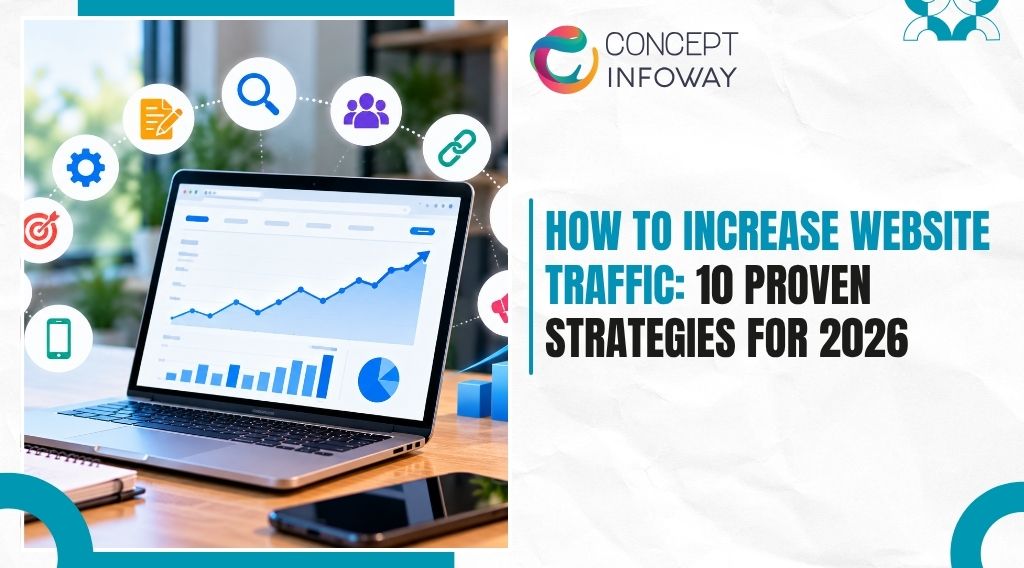
How to Increase Website Traffic: 10 Proven Strategies for 2026
How to increase website traffic starts with understanding why your current visitors are not arriving, engaging, or converting—not simply publishing more pages.
If your website has strong products or services but inconsistent visibility, the problem may involve search intent, technical performance, content quality, conversion friction, or a combination of these factors.
In this guide, you will learn 10 practical website traffic strategies for 2026, including how to strengthen technical SEO, create content that earns visibility, improve local and commercial search performance, and measure website traffic growth without relying on misleading spikes.
You will also learn when SEO services or an SEO company in USA can provide useful support and how to choose an approach that fits your business.
How to Increase Website Traffic With a Search-Led Strategy
Increasing traffic sustainably requires more than chasing high-volume keywords. The most valuable visitors usually come from searches that reveal a specific need, such as comparing providers, evaluating a solution, solving a problem, or preparing to make a purchase.
Your strategy should connect those search needs to useful pages and a clear next step.
Before changing your website, establish a baseline. Review organic sessions, non-branded impressions, clicks, engaged visits, conversions, top landing pages, and queries that already place your site near the first page.
A page ranking in positions 8 through 20 may need better coverage and internal linking, while a page with impressions but few clicks may need a clearer title and description. Conversion data can refine how to increase website traffic for business value.
Start With a Traffic and Conversion Diagnosis
Separate traffic problems from conversion problems. If impressions are low, investigate keyword targeting, indexing, content coverage, and authority.
If impressions and clicks are healthy but leads are weak, examine page relevance, trust signals, calls to action, forms, mobile usability, and the quality of the offer. A stronger baseline helps show how to increase website traffic responsibly.
This distinction prevents a common mistake: trying to solve every business problem by publishing more blog posts.
A website can attract thousands of visitors and still produce little commercial value if visitors land on pages that do not answer their questions or explain what to do next.
Map Search Intent to the Right Page
Search intent is the reason behind a query. Informational searches usually need guides, explanations, or tutorials. Commercial searches often need service pages, comparisons, case examples, or buying guidance.
Transactional searches need a direct path to contact, purchase, booking, or quotation. Search intent is central to understanding how to increase website traffic.
Create a simple map that connects each priority topic to one primary page. This reduces keyword cannibalization, where several pages compete for the same query, and gives your internal linking structure a clearer purpose.
It also helps marketing and sales teams see which pages support awareness and which pages support revenue.
A practical baseline should include:
- Organic traffic by landing page and device type
- Rankings and impressions for priority non-branded queries
- Leads, sales, calls, or other meaningful conversions from organic visits
- Indexed pages, crawl issues, page speed, and mobile usability
Traffic optimization becomes more reliable when every change has a starting measurement and a business reason. This can reveal how to increase website traffic without chasing irrelevant visits.
Ready to Increase Traffic and Conversions? Get Expert SEO Support!
Get A Free QuoteBuild Technical Foundations That Support Website Traffic Growth
Technical SEO does not replace useful content, but it determines whether search engines and visitors can access, understand, and use that content.
A technically weak site can waste the value of good marketing because important pages may load slowly, compete with duplicates, or remain difficult to discover.
Improve Crawling, Indexing, and Site Architecture
Begin by checking whether your important pages are indexable and appear in search results as intended. Review robots directives, XML sitemaps, canonical tags, redirects, status codes, and accidental noindex settings.
These checks are especially important after a redesign, migration, platform change, or major URL restructure. This evidence supports decisions about how to increase website traffic.
Then examine the site architecture. Important commercial pages should not be buried several clicks deep from the homepage or disconnected from relevant content.
A logical structure helps users move from broad topics to specific services, products, or resources while giving search engines context about how pages relate to one another. The data helps teams understand how to increase website traffic sustainably.
Avoid creating large numbers of near-identical pages only to target minor keyword variations. Such pages can dilute internal authority, create maintenance problems, and make it harder to demonstrate genuine expertise.
Build a page when it serves a distinct audience, location, service, or search need. Anyone planning how to increase website traffic should consider this factor.
Make Performance and Mobile Experience Part of SEO
A page that technically ranks can still lose visitors if it feels slow or difficult to use. Review loading behavior on mobile devices, especially for pages with large images, third-party scripts, pop-ups, videos, or complex forms.
Performance work may involve image compression, better caching, script reduction, improved hosting configuration, or changes to the page design.
Do not optimize speed in isolation. Removing a useful comparison tool or essential trust element may reduce engagement even if a benchmark improves.
The practical goal is a fast, stable page that helps the visitor complete the intended task. The same principle applies when planning how to increase website traffic.
Use Structured Information Carefully
Structured data can help search engines interpret information such as products, services, organizations, articles, reviews, events, or frequently asked questions when the markup accurately reflects visible page content. It is not a shortcut to rankings, and incorrect or misleading markup can create quality issues.
Technical website traffic optimization should be treated as an ongoing operating process rather than a one-time checklist.
New templates, plugins, campaigns, and content releases can introduce problems, so include technical reviews in your regular marketing schedule. Teams evaluating how to increase website traffic should connect this with conversions.
Ready to Generate More Leads? Get Website Traffic Growth Solutions!
Get A Free QuoteCreate Content That Earns Relevant Organic Visits
Content is one of the most visible website traffic strategies, but publishing volume alone rarely produces consistent growth.
Strong content addresses a real question at the right stage of the buyer journey, demonstrates practical understanding, and gives readers enough clarity to take the next step. Businesses asking how to increase website traffic should track this signal.
Prioritize Topics by Business Value
Build your editorial plan around three groups of topics. The first group covers problems your potential customers are actively trying to solve.
The second explains how to evaluate options, providers, features, or approaches. The third supports high-intent searches related to your services, products, locations, or industries.
A useful topic is not necessarily the one with the largest search volume. A narrower query from a well-matched prospect may generate more business value than a broad term that attracts casual readers.
Evaluate topics using relevance, intent, competition, existing authority, conversion potential, and the quality of page you can realistically produce. This gives teams a clearer view of how to increase website traffic.
Make Each Page More Useful Than a Generic Summary
Before writing, review what a reader needs to decide or do after the page. Include practical steps, limitations, examples, common mistakes, decision criteria, and signs that a different approach may be appropriate.
Explain the reasoning behind recommendations instead of presenting a list of surface-level tips. This evidence helps prioritize how to increase website traffic next.
For example, an article about increasing ecommerce traffic should not stop at recommending product descriptions.
It should address category structure, filters, duplicate content, inventory changes, product schema, internal links, user-generated content, and the relationship between organic visibility and conversion rate. This is a practical part of learning how to increase website traffic.
Use clear page titles, descriptive headings, concise introductions, and direct answers to important questions. Add original observations from customer work, internal processes, testing, or implementation experience where appropriate.
Those details make content more useful to people and more understandable to systems that summarize information for searchers.
Refresh Content Based on Evidence
A page that once performed well can lose visibility when search behavior, competitors, products, or customer expectations change. Review pages with declining clicks, outdated examples, weak engagement, or rankings just outside the strongest results.
Update the substance, not only the date. Search visibility is only one part of how to increase website traffic.
Check whether the search intent has shifted. A query that once favored a long guide may now favor a comparison, service page, tool, or concise answer.
If the correct format has changed, a small edit may not be enough; the page may need restructuring or consolidation.
Content production works best when it is connected to internal links, conversion paths, subject-matter review, and measurement.
SEO services can help with research, content planning, optimization, and technical coordination, but the business must still provide accurate information about its customers, offers, processes, and limitations. User experience affects how to increase website traffic and keep visitors engaged.
Expand Visibility Through Authority, Local Search, and User Experience
Once your technical foundation and core content are reliable, expand how people discover and evaluate your business. Authority is not just a number from an SEO tool.
It is the combined effect of relevant references, recognizable expertise, trustworthy information, strong user experience, and consistent business details.
Earn Relevant Mentions and Links
Links from relevant, credible websites can help search engines discover and evaluate your pages, but acquisition should focus on genuine value rather than volume.
Useful assets may include original research, practical tools, expert commentary, local resources, data-led explanations, or detailed guides that other organizations would reasonably reference. Measurement helps clarify how to increase website traffic more efficiently.
Avoid buying low-quality links, using automated outreach at scale, or placing your business in unrelated directories solely for a ranking benefit.
Those tactics can create risk without improving the experience for potential customers. A smaller number of relevant references is generally more useful than a large collection of disconnected mentions.
Strengthen Local Search Signals Where Relevant
Businesses serving a defined area should keep their business name, address, phone information, service details, and operating information accurate wherever customers may encounter them.
A complete and maintained business profile can help searchers understand what you offer, where you serve, and how to contact you. Sustainable growth depends on understanding how to increase website traffic strategically.
Local content should be genuinely useful. Explain service areas, customer considerations, regional challenges, or location-specific processes rather than creating thin pages that change only the city name.
Local search performance also depends on reviews, reputation, proximity, relevance, and factors that vary by market and search context.
Improve the Experience After the Click
A traffic increase is not successful if visitors cannot find the answer, trust the business, or complete the next step.
Review navigation, readability, contrast, form length, calls to action, contact options, and the consistency between the search result and landing page. Technical quality matters when deciding how to increase website traffic.
Consider a visitor searching for an SEO company in USA.
If the landing page makes broad claims but does not explain the process, deliverables, communication model, measurement approach, or business fit, the visitor may leave even if the page ranks well. Clear expectations are a conversion asset.
Useful experience improvements often include:
- Matching each landing page to the intent and wording of the searcher
- Showing relevant proof, process information, and next-step expectations
- Reducing unnecessary form fields and clarifying what happens after submission
Concept Infoway can support businesses that need SEO services alongside web design, development, or website optimization.
That combined perspective is helpful when traffic issues are connected to site structure, page templates, technical limitations, or conversion friction rather than content alone. Authority is another factor in how to increase website traffic organically.
You may also like: SEO Strategy: A Complete Guide to Ranking Higher in Local Search
Measure Website Traffic Strategies and Turn Data Into Better Decisions
The final strategy is to create a measurement and improvement cycle. SEO rarely moves in a perfectly straight line, and individual ranking changes do not always indicate business progress.
A useful reporting system connects visibility to qualified visits, engagement, leads, revenue, and the actions your team can take next.
Choose Metrics That Reflect the Business Goal
Track impressions and clicks to understand search visibility, but do not treat them as the final outcome. Review landing-page engagement, conversion rate, qualified inquiries, sales opportunities, revenue where available, and assisted conversions.
For local businesses, calls and direction requests may matter more than a form submission. For ecommerce companies, product views, add-to-cart actions, and transactions may be more relevant. Consistent optimization supports how to increase website traffic over time.
Use consistent definitions. Teams can reach different conclusions if one person reports all organic sessions while another reports only non-branded traffic or qualified leads.
Document filters, attribution rules, reporting periods, and the meaning of each primary metric. Content quality influences how to increase website traffic over time.
Test Improvements in a Controlled Way
Change one meaningful variable at a time when possible. If you rewrite a title, replace the content, redesign the page, and change the call to action simultaneously, you may improve performance without knowing why—or create a decline that is difficult to diagnose.
Prioritize pages based on opportunity. A page with strong impressions, a relevant offer, and a position near the first page may deserve attention before a brand-new topic with no established authority.
Similarly, a high-traffic page with poor lead quality may need better qualification rather than more promotion. Businesses exploring how to increase website traffic should review this regularly.
You may also like: SEO and Content Strategy: The Complete Guide to Search Visibility
Plan for Search Behavior in 2026
Search results increasingly provide summaries, local packs, product information, videos, images, and other formats alongside traditional listings.
This makes it important to provide clear, authoritative information that can be understood in context, while still giving users a reason to visit your site. Page quality is essential to any plan for how to increase website traffic.
Do not build a strategy around an assumed traffic guarantee from any search feature. Search interfaces, algorithms, competitor activity, and user behavior change.
Focus on durable assets: accurate service pages, useful original content, clear business information, strong technical quality, and a satisfying experience after the click.
A capable SEO company in USA should be willing to explain what is being changed, why it matters, how results will be evaluated, and what assumptions remain uncertain.
Ask for reporting that supports decisions rather than dashboards filled with metrics that do not connect to your business.
According to industry reports, the global SEO services market is projected to grow from USD 74.9 billion in 2025 to USD 83.98 billion in 2026 and reach approximately USD 148.86 billion by 2031. This represents a compound annual growth rate (CAGR) of 12.12% from 2026 to 2031.
Wrapping Up
How to increase website traffic is not a single tactic or a quick campaign. Sustainable website traffic growth comes from combining technical accessibility, intent-led content, relevant authority, local visibility where appropriate, a strong user experience, and disciplined measurement.
Start with a diagnosis rather than a guess. Fix obstacles that prevent important pages from being found or used, build content around real customer decisions, strengthen trust, and improve the pages that already show potential.
Then measure qualified outcomes and refine the work based on evidence. Knowing how to increase website traffic also requires this level of measurement.
If your team needs help connecting SEO services with website structure, content, development, or conversion improvements, Concept Infoway can help assess the practical relationship between those areas.
The right next step is a clear review of your current visibility, business goals, technical condition, and highest-value opportunities—not a promise based on traffic numbers alone.
FAQs - How to Increase Website Traffic
How can I increase website traffic in 2026?
Start with technical SEO, search-intent research, useful content, internal linking, local visibility where relevant, and conversion improvements. Measure qualified visits and leads, not traffic volume alone.
How long does it take to increase organic website traffic?
The timeframe varies by site condition, competition, content quality, authority, and resources. Some technical improvements may help sooner, while sustainable organic growth usually requires consistent work and measurement. Teams deciding how to increase website traffic should include this in the plan.
Which SEO services help increase website traffic?
Useful SEO services may include technical audits, keyword and intent research, content strategy, on-page optimization, internal linking, local SEO, authority development, analytics, and ongoing performance improvements.
Should I hire an SEO company in USA or manage SEO internally?
Internal teams can manage SEO when they have sufficient technical, content, and analytical expertise. An SEO company in USA may help when resources are limited or website, content, and measurement needs overlap. This work supports a broader plan for how to increase website traffic.
How do I increase organic website traffic without publishing constantly?
Improve existing pages, resolve indexing and performance issues, strengthen internal links, match content to search intent, and update outdated information. Better relevance and usefulness often matter more than publishing volume.
What is website traffic optimization?
Website traffic optimization improves how people find, use, and convert on a site. It combines SEO, technical performance, content relevance, user experience, internal linking, and measurement tied to business goals. This provides useful context for how to increase website traffic.
How should I measure website traffic growth?
Track organic impressions, clicks, landing-page engagement, qualified leads, sales, calls, and revenue where available. Segment branded and non-branded traffic and use consistent attribution rules for reliable comparisons.
Can Concept Infoway help with website traffic strategies?
Concept Infoway can support businesses with SEO services and related website design, development, and optimization needs. The appropriate approach depends on your current site, goals, technical condition, and audience.


.NET Migration: A Step-by-Step Guide for Businesses