







 Web Based Solutions


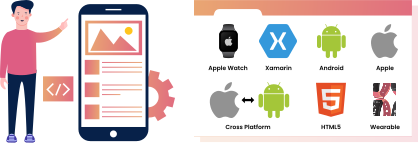
 Mobile App Development







 UI/UX Design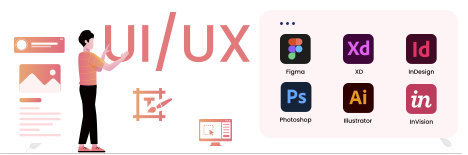
 Digital Marketing



 Quality Assurance


 Managed IT Services
 Web Developers











 Mobile App Developers



 Frontend Developers



 Open Source Developers







 Microsoft Certified Developers



 Cross Platform Developers

 Quality Assurance

 Microsoft
 Open Source
 JS Frameworks
 Business Models
 Intellectual Property Protection
 IT Consulting Services
 IT Outsourcing Services
Top Mobile App Development Trends Every Business Should Know
Mobile app development trends are changing fast, and if you are planning a new app or updating an existing one, the gap between a good product and a costly one often comes down to choosing the right approach early.
Businesses today are not just building apps to have a digital presence; they are using them to improve sales, reduce friction, support customers, and create repeat engagement.
For decision-makers, that means the real challenge is not chasing every new idea. It is understanding which mobile app development trends actually improve user experience, reduce long-term maintenance risk, and support growth.
In this article, we will walk through the trends worth paying attention to, how they affect planning and budgets, and how teams like Concept Infoway help businesses make practical decisions about mobile app development Company , including cross platform app development, Android app development, and modern app architecture choices.
Mobile App Development Trends That Matter for Business Planning
The most useful trends are the ones that solve a real business problem. Some improve speed to market, others reduce development cost, and some help apps stay relevant as customer expectations change.
If you are evaluating a mobile app project now, this section will help you separate meaningful shifts from temporary hype.
Cross Platform Development Is Now a Strategic Default for Many Businesses
Cross platform app development has moved from a compromise to a serious business option for many projects. Instead of building separate native apps for iOS and Android from day one, teams can often launch faster with one shared codebase while still delivering a polished user experience.
That does not mean cross platform is right for every use case. Apps with advanced hardware features, highly specialized animations, or platform-specific performance demands may still benefit from native development.
But for many customer portals, ecommerce apps, booking tools, internal workflows, and service apps, cross platform mobile development services can reduce duplication and make future updates easier to manage. Mobile app development trends are useful when they reduce risk instead of adding complexity.
A practical way to evaluate it is to ask whether your app needs platform-specific depth or whether it mainly needs to ship quickly, scale predictably, and stay maintainable.
If the latter is true, the best cross platform mobile app development approach may provide the right balance of cost, speed, and long-term flexibility. Mobile app development trends should make the app clearer, faster, or easier to maintain.
Ready to Lead the Mobile Market? Build Your Next-Generation App!
Get A Free QuoteThe Right Framework Choice Has a Bigger Impact than Before
A cross platform app development framework is not just a technical preference anymore. It affects development speed, hiring, maintenance, performance tuning, and how easily your app can evolve later. Businesses are paying more attention to framework fit because changing direction after launch is expensive.
The main decision is rarely about what is trendy. It is about whether the framework supports your product goals, your performance requirements, and your internal team or vendor capabilities.
When an app is expected to grow into new features, device types, or integrations, the framework needs to support that path without creating avoidable complexity. This is where mobile app development trends become planning signals rather than distractions.
For businesses that want guidance on architecture decisions, Concept Infoway often helps evaluate whether a project should lean toward native, cross platform, or a hybrid strategy based on the app’s actual business goals rather than a one-size-fits-all rule.
Android-First Planning Still Matters in Many Markets
Even when cross platform app development is the final direction, Android app development still influences planning in a major way. Android remains a critical platform for many industries, especially where device variety, budget sensitivity, or broad market reach matter.
An Android-first mindset is helpful when your audience includes field teams, service staff, retail customers, or users in price-sensitive segments. It also matters when device compatibility and operating system fragmentation need more careful testing.
Businesses that ignore Android behavior during planning often run into avoidable issues after launch, especially with layout consistency, permissions, push notifications, and device performance.
A good development strategy should account for Android testing early, even if the app will also support iPhone users. That helps reduce post-launch fixes and makes the product feel more stable across real-world devices. The strongest mobile app development trends help businesses plan with fewer surprises.
User Experience Is Becoming a Revenue Decision, Not Just a Design Decision
Modern apps are judged quickly. If users cannot understand the flow, complete a task, or trust the interface, they leave. That is why user experience is now a business metric, not just a design conversation.
The strongest mobile app development trends today focus on reducing friction. That includes simpler onboarding, fewer steps to complete core actions, clearer navigation, and interfaces that make the next step obvious.
Businesses with service apps, ecommerce apps, or customer self-service tools often see that small usability improvements are more valuable than flashy features.
In practice, this means product teams should design around the most important user journey first. If the app exists to book, buy, track, request, or manage something, that core task should be easy to find and complete within a few taps.
Read also: Top 10 Common Mobile App Development Mistakes to Avoid
What Is Changing in User Expectations and App Performance?
Users now expect apps to feel fast, stable, and personalized without becoming complicated. The challenge for businesses is that expectations have risen while attention spans have shortened. This section looks at the forces shaping what people now consider a “good” app.
Faster Load Times and Smoother Interactions Are Non-Negotiable
Many app projects fail not because the idea is weak, but because performance is treated as a late-stage issue.
Users may forgive a missing secondary feature, but they rarely forgive delays, crashes, or confusing loading states. The goal is to use mobile app development trends to build a product that can evolve.
The latest mobile app technologies are increasingly focused on efficiency. That includes better asset handling, smarter caching, smoother screen transitions, and cleaner data handling. Businesses should care because performance affects retention, app store ratings, and support volume.
If users are forced to wait or restart tasks, the product begins to create operational friction instead of removing it. Mobile app development trends can also help teams prepare for post-launch improvement.
For business owners, the takeaway is simple: performance testing should happen throughout development, not only at the end. That applies whether you are building with cross platform mobile development services or a fully native stack.
Personalization Must Feel Helpful, Not Intrusive
Personalization continues to grow, but the best experiences are subtle and useful. People want apps that remember preferences, surface relevant actions, and reduce repetitive input. They do not want an app that feels invasive or overly predictive. Mobile app development trends should support the product’s core workflow first.
This is one reason businesses are being more careful about how they use data. A thoughtful app can personalize the experience based on previous orders, saved settings, preferred locations, or role-based dashboards. Done well, that saves time and increases engagement. Done poorly, it creates trust issues.
The most effective app strategies keep personalization tied to convenience. If a feature does not genuinely help the user move faster or make a better decision, it may not belong in the first release.
Security and Privacy Influence Product Trust
Users are more aware of privacy and security risks than they were a few years ago. They may not understand the technical details, but they do notice signs of carelessness.
Unexpected permissions, vague login flows, and poorly explained data use can damage trust quickly. The strongest mobile app development trends help businesses plan with fewer surprises.
For businesses, security is now part of the product experience. That includes secure authentication, proper access control, safe storage practices, and a transparent approach to permissions. It also means planning for updates, vulnerability management, and basic compliance needs based on the type of data the app handles.
A mobile app development plan should not treat security as a separate phase. It should be part of architecture, interface design, and launch readiness from the start.
Ready to Build the Future of Mobile? Start Your App Today!
Get A Free QuoteHow Businesses Should Evaluate New App Technologies Before Committing
Not every latest mobile app technology belongs in your project. New tools can create advantages, but they can also add risk if they do not match your goals. This section helps you decide what to adopt, what to test, and what to avoid.
Decide Based on Business Goals, Not Trend Pressure
A smart app decision starts with the business outcome. Are you trying to improve sales, reduce service calls, streamline internal operations, or create a new customer channel? The answer changes the right development path. Mobile app development trends should be judged by the value they create for users.
For example, a customer-facing ecommerce app may benefit from a cross platform app development framework that allows faster iteration and consistent branding across devices. A field service app may need stronger offline support and device-specific hardware access.
A highly interactive media experience may need native performance in key areas. The right choice depends on the workflow, not the buzz around the technology. Mobile app development trends are most useful when they align with the user journey.
This is where experienced planning matters. At Concept Infoway, we often see that businesses save time and money when they define the app’s actual job before choosing the stack. Concept Infoway uses mobile app development trends as inputs for practical planning.
Ask Which Features Create Long-Term Value
Every feature adds development, testing, support, and upgrade cost. The best mobile app development trends are the ones that improve the product over time instead of making it harder to maintain.
Before approving a feature, ask whether it helps with acquisition, conversion, retention, operational efficiency, or customer satisfaction. If it does not support one of those outcomes, it may be a distraction. This is especially important when teams are under pressure to add too many capabilities to the first release.
A lean first version usually performs better than an overloaded launch. It gives you more room to learn from real users and expand in the right direction.
Build for Adaptability, Not Just Launch Day
The apps that age well are the ones built to change. That means choosing architecture and development practices that allow updates without forcing a full rebuild too soon.
This matters because product expectations rarely stay still. New payment methods, new integrations, customer support tools, analytics requirements, and operating system changes all create pressure after launch. If the app cannot adapt, maintenance becomes more expensive and slower. A practical review of mobile app development trends keeps technology choices grounded.
Businesses should think about adaptability during the planning stage. A well-structured app can grow in features and complexity without losing stability, which is often more valuable than a short-term shortcut. Mobile app development trends should be reviewed before features are locked into scope.
You may also like: Why Businesses Choose Android App Development Agency
Where Mobile App Development Is Heading Next
The next wave of app development is not only about new features. It is about making apps more responsive to user behavior, more connected to business systems, and easier to maintain.
These shifts matter because they shape the decisions you make now. Mobile app development trends give decision-makers a better way to compare development paths.
Smarter Automation Will Reduce Repetitive User Work
Apps are becoming better at handling repeated tasks automatically. That can include pre-filling forms, suggesting next steps, surfacing alerts, or simplifying routing between screens. The goal is to reduce friction without making the app feel rigid. That is why mobile app development trends need business context before adoption.
For businesses, automation is valuable when it removes repetitive work from customers or employees. A service company, for example, may use an app to streamline scheduling, status updates, and task submission.
An ecommerce business may use automation to simplify reorder flows or customer account actions. Mobile app development trends matter most when they improve everyday usability.
The important thing is that automation should save time without removing user control. People still want to confirm, adjust, and understand what is happening. The right mobile app development trends make future updates easier to manage.
Better Integration with Business Systems Will Become Standard
Modern apps rarely operate alone. They need to connect with CRM tools, inventory systems, payment processors, analytics platforms, and internal dashboards. That is why integration planning is now central to mobile app development.
A strong app does not simply look good on the surface. It fits into the business workflow behind the scenes. If data does not flow cleanly between systems, staff end up duplicating work and customers experience delays or inconsistent information.
Businesses evaluating mobile app development trends should pay close attention to how the app will connect with existing tools. In many cases, integration quality has more impact on ROI than a cosmetic feature set.
App Maintenance Is Becoming a Strategic Function
More businesses now recognize that launch is only the beginning. Apps need version updates, bug fixes, platform compatibility checks, security monitoring, and feature refinements. If maintenance is not planned correctly, the app gradually becomes less reliable.
This is one reason businesses are choosing development partners who understand not just build quality, but post-launch support planning. An app that is easy to maintain is easier to improve. That directly affects user satisfaction and total cost of ownership.
For companies considering mobile app USA audiences or national rollout plans, maintenance strategy is especially important because device diversity, user expectations, and platform updates can create ongoing demands.
Apps Will Continue Moving Toward Real-Time, Context-Aware Experiences
Users now expect apps to respond quickly to context. That can mean live order tracking, instant notifications, dynamic content, or location-aware actions when appropriate.
The goal is to make the app feel current and useful instead of static. This is where mobile app development trends become planning signals rather than distractions.
This trend is powerful, but it also needs restraint. Real-time features should solve a clear problem. If they are added only because they seem modern, they can increase complexity without improving the product. Strong mobile app development trends help the product stay relevant after launch.
The best implementation is always the one that matches user intent. If a real-time experience saves time, improves confidence, or reduces uncertainty, it is worth considering. Otherwise, simpler may be stronger. The best mobile app development trends support both user satisfaction and operating efficiency.
You may also like: What to Look for in a Mobile App Development Company in USA
How to Choose the Right Mobile App Approach for Your Business
Choosing the right app approach is less about following a trend and more about matching the solution to your goals, budget, and timeline. This section helps you turn the trends into a practical decision. A thoughtful look at mobile app development trends helps prevent overbuilding the first release.
Start with the User Journey You Need to Support
Before you choose a platform or framework, identify the main job the app must do. The more clearly you understand the user journey, the easier it becomes to decide whether native, cross platform, or a mixed approach makes sense. Businesses should connect mobile app development trends to measurable product goals.
If the app must deliver a streamlined customer experience across iPhone and Android, cross platform app development may be the most efficient route.
If the app needs deeper device access, more specialized performance, or very tailored platform behavior, native development may be the better investment. The answer depends on how the app will be used. Mobile app development trends can guide better architecture, testing, and rollout decisions.
Compare Launch Speed, Maintenance, and Flexibility
The best choice is rarely the one that is strongest in just one area. It is usually the one that balances launch speed, future maintenance, and room to grow. A practical review of mobile app development trends keeps technology choices grounded.
Here is the practical trade-off businesses should consider:
- Faster launch can help validate the idea sooner, but it should not sacrifice basic quality.
- Lower maintenance overhead can reduce long-term cost, but only if the framework fits the product.
- Greater flexibility can support future expansion, but only when the architecture is planned well from the start.
This is why many businesses ask for cross platform mobile development services when they want a balanced starting point rather than a highly specialized build. Mobile app development trends also influence how teams balance speed and maintainability.
The global Mobile App Development Market was valued at approximately USD 94.4 billion in 2024, according to Market Research Future. The market is expected to increase from USD 116.87 billion in 2025 to nearly USD 988.5 billion by 2035, reflecting significant growth in the mobile app development industry over the forecast period.
Choose a Team That Understands Both Business and Technical Risk
A strong development team does more than write code. It helps you avoid building the wrong thing, overcomplicating the first release, or selecting a structure that becomes difficult to maintain. Mobile app development trends are useful when they reduce risk instead of adding complexity.
When you evaluate a partner, pay attention to how they discuss product goals, user experience, testing, integrations, and post-launch support. Those are usually better indicators of success than technical buzzwords alone.
Concept Infoway works with businesses that want practical guidance across strategy, design, and development, including Android app development, cross platform app development, and related digital services. The value is not just delivery.
It is building an app that fits the business and is ready to evolve. Mobile app development trends should be judged by the value they create for users.
Plan for a Phased Rollout When the Project Is Uncertain
If you are not fully sure which features users will value most, a phased rollout can be the safest approach. Start with the core workflow, validate how real users behave, then add the next layer of value.
This approach lowers risk and gives you better feedback than trying to predict everything in advance. It is especially useful for businesses launching in a competitive market or creating a new digital service with little historical data.
A phased plan also supports stronger budgeting. You can make smarter decisions after seeing how the first version performs instead of assuming the answer before launch.
Wrapping Up
The most important mobile app development trends are the ones that improve usability, support business goals, and keep your app easier to maintain over time. Cross platform development, stronger Android planning, better performance, deeper integrations, and more thoughtful personalization all matter, but only when they solve a real business need.
If you are planning a new app or refining an existing one, focus less on what is newest and more on what will help users complete tasks faster, help your team manage the product more efficiently, and help your business grow with less risk.
That is the practical standard we use at Concept Infoway when helping clients evaluate mobile app development decisions. The right app strategy is the one that fits the work your business actually needs done.
FAQs - Mobile App Development Trends
What Are the Most Important Mobile App Development Trends for Businesses Right Now?
The biggest trends are cross platform development, faster performance, stronger security, smarter personalization, and deeper system integration. The right mix depends on your business goals and user needs.
Is Cross Platform App Development Better than Native App Development?
Not always. Cross platform app development is often faster and more cost-efficient, while native apps can be better for advanced performance or device-specific features. The best choice depends on the app’s purpose.
When Should a Business Choose Android App Development First?
Android-first planning makes sense when your audience is broad, budget-sensitive, or heavy on Android devices. It is also useful when device variety and compatibility testing matter early in the project.
What Is a Cross Platform App Development Framework Used for?
A cross platform app development framework lets teams build one codebase for multiple mobile platforms. It can speed up launch, simplify updates, and reduce duplicate development work when used for the right project. Mobile app development trends also influence how teams balance speed and maintainability.
How Do I Know If My Business Should Use Cross Platform Mobile Development Services?
Use cross platform mobile development services when you want one app experience across iOS and Android without building two separate apps. It works well for many customer, ecommerce, and business workflow apps. Mobile app development trends give this answer a practical frame for long-term planning.
What Latest Mobile App Technologies Should Businesses Pay Attention to?
Businesses should watch technologies that improve performance, security, automation, analytics, and integrations. The best choices are the ones that support real user needs instead of adding complexity. Mobile app development trends help clarify which ideas deserve early investment.
How Can Mobile App Development Trends Affect Long-Term Maintenance Costs?
The framework, architecture, and feature choices you make now can either reduce or increase maintenance later. A well-planned app is easier to update, test, and scale, which helps control long-term cost. A business-focused view of mobile app development trends keeps the project from chasing novelty.
Can Concept Infoway Help with Mobile App USA Projects and Cross Platform Builds?
Yes. Concept Infoway supports businesses with mobile app USA projects, cross platform app development, and Android app development, with a focus on practical planning, user experience, and maintainable builds.


Website Accessibility Audit: A Complete Guide for Businesses