






 Web Based Solutions



 Mobile App Development








 UI/UX Design
 Digital Marketing


 Quality Assurance


 Managed IT Services
 Web Developers











 Mobile App Developers



 Frontend Developers



 Open Source Developers







 Microsoft Certified Developers



 Cross Platform Developers

 Quality Assurance

 Microsoft
 Open Source
 JS Frameworks
 Business Models
 Intellectual Property Protection
 IT Consulting Services
 IT Outsourcing Services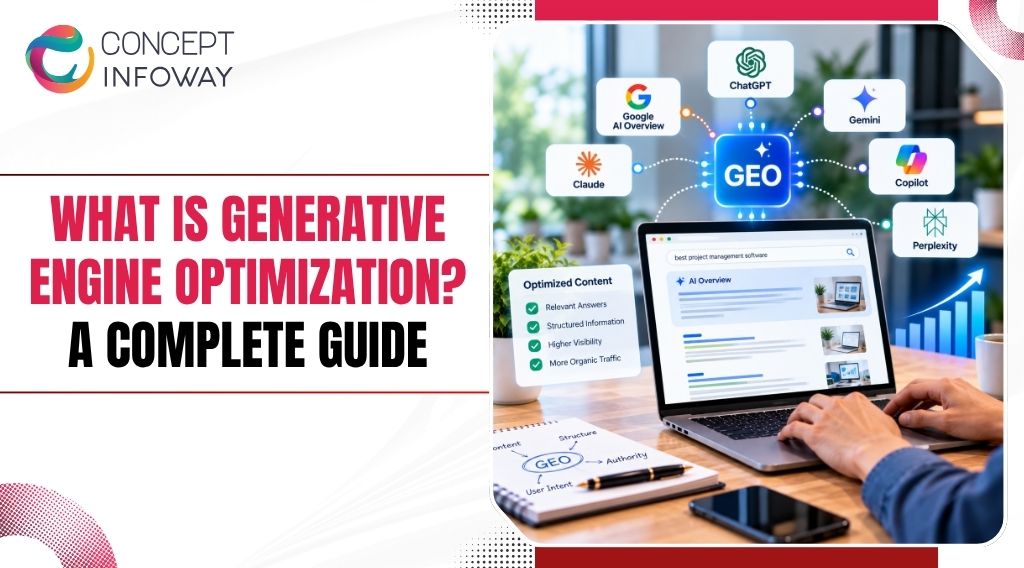
What Is Generative Engine Optimization? A Complete Guide
Generative engine optimization helps your business appear in AI-generated answers when customers search for products, services, and solutions in conversational tools instead of traditional search results.
If your company has strong website content but rarely earns citations, mentions, or recommendations in AI responses, your SEO strategy may need to address more than rankings and clicks.
AI search is changing how people discover and compare businesses, but it does not replace the fundamentals of search optimization. It adds new visibility opportunities and new technical, editorial, and measurement challenges.
This guide explains how generative engine optimization works, what influences AI search visibility, how to build a practical strategy, and how to evaluate an SEO services partner for the next stage of organic growth.
What Is Generative Engine Optimization?
Generative engine optimization, often called GEO, is the process of improving a brand’s ability to be accurately understood, considered, cited, and recommended by AI-powered search experiences. These experiences may summarize information from multiple sources instead of presenting only a traditional list of blue links.
The objective is not to manipulate an AI system or guarantee that a brand will appear in every generated answer.
The practical objective is to make a business, its expertise, and its online information clear enough for search systems to use when forming an answer.
How GEO Differs From Traditional SEO
Traditional SEO focuses heavily on helping pages become discoverable and competitive in conventional search results. It involves technical accessibility, relevant content, internal linking, authority, page experience, and alignment with search intent.
Generative engine optimization includes those same foundations, but it places additional emphasis on whether information can be extracted, interpreted, compared, and attributed in an AI-generated response.
A page may rank well for a keyword yet contribute little to an AI answer if its information is vague, poorly organized, unsupported, or difficult to distinguish from similar content.
A useful way to think about the relationship is:
- SEO helps search engines find, understand, and rank your pages.
- GEO helps search systems recognize your expertise and use your information in conversational answers.
- Strong SEO remains the foundation because AI systems still depend on crawlable, relevant, and trustworthy web content.
GEO is therefore not a separate replacement for SEO. It is an evolution of search visibility in which rankings, citations, brand mentions, and answer inclusion all matter. This consideration belongs in ongoing generative engine optimization reviews.
Why Businesses Are Paying Attention to AI Search
A customer researching a software platform, healthcare service, legal provider, ecommerce product, or marketing agency may now ask an AI search tool to recommend suitable options.
The question can include multiple conditions, such as location, budget range, business size, technology requirements, or a specific problem. Clear structure strengthens generative engine optimization across important pages.
That type of search compresses several conventional searches into one conversation. Instead of visiting ten pages, a user may first review an AI-generated comparison and then investigate a smaller group of businesses.
If your company is absent from the information sources used to form that answer, a strong traditional ranking may not be enough to enter the consideration set.
This shift also makes accuracy more important. Incomplete service descriptions, inconsistent company information, unsupported claims, and outdated pages can affect how systems interpret a business.
AI search visibility is not simply a matter of repeating more keywords. It depends on the quality and consistency of the information available across the web. Accurate source information strengthens generative engine optimization.
Ready to Grow Your Brand Visibility? Get Professional GEO Solutions!
Get A Free QuoteHow Do AI Search Systems Evaluate Business Information?
AI search systems do not use one publicly documented formula that businesses can follow. Different platforms may retrieve information, process language, evaluate sources, and generate answers in different ways.
For that reason, responsible GEO focuses on durable signals rather than shortcuts. Technical quality remains an important part of generative engine optimization.
The common thread is that a system needs to identify what a business does, determine whether its information appears relevant and reliable, and connect that information with a user’s question.
Relevance and Intent Alignment
A page should answer the question a customer is actually asking. A generic service page that repeats broad claims may be less useful than a detailed page addressing a specific business situation. It gives generative engine optimization a clearer information foundation.
For example, “SEO services” is a broad topic. A business owner may really want to know how to improve organic leads after a website redesign, how local and national SEO differ, or how to measure results when AI summaries reduce clicks.
Content that addresses those decision points gives search systems clearer context and gives readers more practical value.
Review your content by asking whether each important page clearly explains its audience, problem, service, process, limitations, and expected decision. If a visitor must infer those details from vague marketing language, an AI system may also struggle to represent the page accurately.
Expertise and Evidence
AI-generated answers need useful source material. Pages that demonstrate first-hand knowledge tend to be more valuable than pages assembled from general definitions. The page structure can make generative engine optimization more effective.
Practical evidence can include explanations of common implementation problems, examples of how a process works, quality-control steps, technical considerations, decision frameworks, and clearly stated assumptions.
You do not need to reveal confidential client information or make unsupported performance claims. You do need to show that the content reflects real understanding.
For a service company, that may mean explaining how an SEO team audits a website, prioritizes technical issues, maps content to intent, reviews conversion paths, and reports progress.
The detail should help a prospective customer make a better decision rather than simply persuade the reader to submit a form.
Clarity, Structure, and Extractable Answers
Well-structured content is easier for people and machines to navigate. Descriptive headings, concise definitions, clear comparisons, meaningful lists, tables where appropriate, and direct answers all reduce ambiguity. This makes generative engine optimization easier to connect with user intent.
This does not mean every page should be reduced to short snippets. Complex topics require context. A strong page usually gives a direct answer first, then explains the reasoning, trade-offs, examples, and next steps.
Use consistent terminology for your services, industries, locations, technologies, and business model. If the company calls a service one thing on its homepage and something materially different on another page, both readers and search systems may have difficulty determining what the business actually offers.
Trust and Source Consistency
Trust is built across more than one page. Important business facts should be consistent on the website and on relevant third-party profiles.
This includes the company name, service descriptions, contact information, locations where services are offered, and statements about capabilities. Consistency is especially important for generative engine optimization.
Do not create pages for locations, industries, or services that the business cannot genuinely support. Artificial expansion can create thin content, confuse potential customers, and weaken the reliability of your website.
Structured data can help clarify entities such as an organization, service, article, or product when implemented accurately. It is not a guarantee of rich results or AI inclusion, and it should never be used to mark up information that users cannot see or verify.
Make Your Brand More Discoverable in AI Search with Expert Support!
Get A Free QuoteHow to Build a Generative Engine Optimization Strategy
A useful GEO strategy starts with the customer journey, not with a list of AI platforms. The goal is to identify the questions that influence discovery and selection, then build a reliable information system around those questions.
The strongest programs combine technical SEO, content strategy, conversion optimization, digital PR or brand authority work where appropriate, and ongoing measurement. Each part supports a different stage of visibility.
Map the Questions Behind the Search
Begin by collecting the questions customers ask before they contact your business. Include informational, comparison, service, pricing, implementation, and location-related questions. This gives teams a more disciplined generative engine optimization process.
A buyer looking for an SEO company in the United States may ask what an SEO engagement includes, how to compare providers, whether technical SEO or content should come first, and how an agency reports business impact.
These are more useful starting points than simply producing another page targeting “SEO services.”
Organize questions by decision stage. Early-stage questions explain a problem. Middle-stage questions compare approaches and providers. Late-stage questions address scope, process, communication, measurement, and fit.
This map helps prevent a common mistake: publishing many introductory articles while leaving important buying questions unanswered. This is where generative engine optimization benefits from consistent business information.
Build Topic Depth Around Real Expertise
Topic depth does not mean producing the longest possible article. It means covering the connected information a reader needs to understand and act.
A strong topic cluster might include a core service page, supporting explanations, comparison content, implementation guidance, measurement resources, and case-based insights. Internal links should make the relationship between these pages clear.
A visitor reading about AI search optimization should be able to move naturally to related SEO services, website optimization, content strategy, or technical development support when those services are relevant.
Avoid creating near-duplicate pages that change only a city name or keyword. Location-specific content should explain meaningful differences in audience, market, service context, or customer needs.
Otherwise, it can create a large site with little additional value. This should be documented as part of the generative engine optimization process.
Make Important Pages Easy to Understand
Every high-value page should answer several basic questions quickly: What is this page about? Who is it for? What problem does it address? What does the business provide? What should the reader do next? This supports generative engine optimization without replacing traditional SEO.
Use descriptive page titles and headings. Put the most important explanation near the beginning, but give readers enough detail to assess the service. Explain terminology when it may be unfamiliar. Separate factual statements from opinions and avoid presenting predictions as guarantees.
A service page should also connect the offering to business outcomes without promising a fixed result.
For example, technical SEO can improve crawlability and help search engines understand a site, but rankings and leads also depend on competition, content quality, demand, site experience, and many external factors.
Strengthen the Technical Foundation
AI search optimization cannot compensate for a website that search engines cannot reliably access or interpret.
Technical review should cover indexability, crawl paths, canonicalization, rendering, structured data, page speed, mobile usability, redirects, duplicate content, and important errors. This can improve the signals used in generative engine optimization.
The right priorities depend on the site. A small brochure website may need clearer service architecture and stronger conversion paths.
An ecommerce website may need product data, faceted navigation controls, category structure, and scalable templates. A large business website may need governance so new pages remain consistent and technically sound.
Technical work should be tied to a business reason. Fixing an issue is more valuable when you can explain which users, pages, conversions, or search interpretations it affects. The same principle applies to generative engine optimization measurement.
Earn Recognition Without Manufacturing It
AI systems may draw from a broad information environment, including a company’s own website and other credible sources. Brand mentions, editorial references, partnerships, reviews, professional profiles, and useful contributions to industry discussions can all support recognition when they are genuine and relevant.
Do not approach this as a campaign to place a brand name everywhere. Unrelated mentions, low-quality publications, and artificial review patterns can create risk rather than authority.
The durable approach is to publish useful information, participate where the business has real expertise, and ensure that important claims can be supported.
For companies evaluating a partner, this is one reason to look beyond promises about rankings. Ask how the provider develops authority, validates information, protects brand trust, and connects visibility work to qualified business opportunities.
According to industry reports, the global SEO services market is projected to grow from USD 74.9 billion in 2025 to USD 83.98 billion in 2026 and reach approximately USD 148.86 billion by 2031. This represents a compound annual growth rate (CAGR) of 12.12% from 2026 to 2031.
How Should You Measure AI Search Visibility?
Measurement is one of the least settled parts of generative engine optimization. AI responses can change based on the platform, query wording, user context, location, time, available sources, and model behavior. A single observation does not prove a stable trend.
The answer is not to ignore measurement. It is to use a broader scorecard that combines traditional SEO data, brand signals, conversion data, and structured observations of AI-generated answers.
Track Visibility as a Set of Signals
Monitor whether the business is appearing for a representative group of questions, whether the description is accurate, which sources are referenced, which competitors are mentioned, and whether the answer presents the business in an appropriate context.
Record the query, platform, date, location assumptions, response summary, citations or links shown, and any factual errors.
Repeating the same review over time can reveal patterns, but results should be treated as directional rather than guaranteed. This helps generative engine optimization avoid vague or unsupported claims.
Traditional data remains essential. Review organic impressions, clicks, rankings, branded searches, nonbranded traffic, engagement, form submissions, calls, ecommerce actions, and qualified leads.
AI summaries may change click behavior, so a decline in clicks does not automatically mean a decline in demand, and an increase in impressions does not automatically mean business growth.
Connect Visibility to Conversions
The commercial value of GEO depends on what happens after discovery. A visitor who arrives through a search result, an AI citation, a branded query, or a direct visit should encounter a page that supports the next decision.
Review landing-page relevance, calls to action, inquiry quality, form completion, consultation requests, and sales feedback.
Ask whether prospects understand the service before the first conversation and whether they mention content or answers that influenced their decision. The detail helps generative engine optimization remain accurate and useful.
Attribution will often be imperfect. Use multiple sources of evidence instead of assigning all value to one channel. CRM notes, assisted conversions, branded search trends, analytics, and customer interviews can together provide a more realistic picture.
Avoid Common Measurement Mistakes
One mistake is treating a tool’s generated answer as a ranking position. An AI response is not always stable, and visibility may vary across similar prompts.
Another mistake is chasing mentions without checking accuracy. A wrong description of a service can create poor-fit inquiries and damage trust.
A third mistake is measuring activity instead of outcomes. Publishing more pages, adding more schema, or tracking more prompts does not prove that the program is helping the business.
Each initiative should have a reason, an expected signal, and a review point. A practical generative engine optimization plan should include this work.
A practical reporting cycle can include a technical health review, content performance analysis, query and competitor observation, conversion review, and prioritized recommendations. The exact cadence should reflect the size and complexity of the website rather than a fixed promise.
Keep Human Review in the Process
Automated tools can help identify patterns, but they cannot fully judge whether an AI-generated description is fair, accurate, useful, or aligned with the company’s positioning. Someone familiar with the business should review important findings.
This matters especially for regulated, technical, financial, medical, or high-consideration services. A technically visible page can still create risk if it oversimplifies a requirement, makes an unsupported claim, or fails to explain limitations. This is a core generative engine optimization consideration.
You may also like: How to Maximize ROI with PPC Advertising Management
What Should You Look for in an SEO Partner for AI Search?
The future of SEO with AI will reward businesses that treat search as part of a wider digital experience rather than as an isolated traffic channel.
When comparing SEO companies in the USA or searching for the best search engine optimisation company, evaluate the quality of the thinking and process instead of relying on a label or a promised outcome.
A suitable partner should be able to connect technical work, content, user experience, analytics, and business goals. The provider should also be comfortable explaining uncertainty.
No responsible partner can guarantee inclusion in an AI-generated answer, a specific ranking, or a fixed number of leads. Teams should connect this signal with their generative engine optimization goals.
Questions to Ask Before Choosing a Provider
Ask how the team will learn your products, customers, sales process, competitors, and existing website.
Ask what it will audit first, how priorities will be decided, and which work requires access to development, analytics, or content resources. Reliable evidence gives generative engine optimization more substance.
You should also ask how the provider distinguishes between traditional SEO, AI search optimization, content improvement, digital authority, and conversion optimization.
These activities can overlap, but they are not interchangeable. A clear proposal should explain the role of each activity and how progress will be evaluated.
Look for reporting that includes completed work, findings, business implications, and next decisions. A list of tasks is not enough if you cannot tell which risks were reduced, which opportunities were prioritized, or how the work supports qualified demand.
Warning Signs of a Weak GEO Approach
Be cautious when a provider presents a proprietary trick as a guaranteed way to control AI answers.
Be equally cautious when the strategy consists mainly of generating large volumes of generic content, inserting keywords into every heading, or adding structured data without improving visible information. A strong generative engine optimization approach should account for this signal.
Other warning signs include unclear ownership of content, no review process for factual accuracy, no discussion of conversion paths, and reports focused only on rankings or traffic without business context.
A credible plan should acknowledge that platforms change. It should emphasize assets the business controls, including a technically sound website, useful content, consistent business information, a clear service proposition, and a process for learning from customers and performance data.
How Concept Infoway Can Fit Into the Process
Businesses often need help connecting SEO services with website structure, content, development, analytics, and ongoing optimization.
Concept Infoway supports digital initiatives across SEO, web design, web development, ecommerce, WordPress development company , Laravel, Shopify, PHP development company, and related technology needs where the project requires that combination. This keeps generative engine optimization grounded in useful content.
That broader perspective can be useful when search visibility problems are connected to a slow template, unclear navigation, weak service pages, technical limitations, or a website that does not convert the traffic it receives.
The appropriate starting point depends on the site and business goals, so an initial review should identify the highest-impact problems before work is prioritized.
The right engagement should leave you with a clearer understanding of what needs to change, why it matters, how success will be evaluated, and which work can be handled in sequence.
That clarity is more valuable than adopting a new search acronym without changing the underlying customer experience.
Wrapping Up
Generative engine optimization is best understood as an extension of sound SEO and digital communication.
It helps your business present accurate, useful, well-structured information that search systems can interpret and customers can trust. It does not replace technical quality, relevant content, authority, or conversion-focused website design.
Start by mapping customer questions, improving the pages that influence decisions, strengthening technical foundations, maintaining consistent business information, and measuring both visibility and business outcomes. Review AI-generated descriptions for accuracy, but avoid chasing unstable promises or treating one platform’s response as a permanent ranking.
If your website needs stronger SEO, clearer service architecture, technical improvements, or a more connected digital strategy, Concept Infoway can help evaluate the gaps and prioritize practical next steps.
A thoughtful generative engine optimization program should ultimately make your business easier to understand, easier to find, and easier for the right customers to choose.
FAQs - Generative Engine Optimization
What is generative engine optimization?
Generative engine optimization improves how AI-powered search systems understand, cite, and recommend a business. It builds on technical SEO, useful content, authority, structured information, and accurate brand details.
How is generative engine optimization different from SEO?
Traditional SEO focuses mainly on visibility in conventional search results. Generative engine optimization also considers whether AI systems can accurately interpret, summarize, cite, and recommend your business in conversational answers.
Why does AI search visibility matter for businesses?
Customers increasingly use conversational search to compare services and products. Strong AI search visibility can help your business enter consideration earlier, although inclusion depends on the platform, query, sources, and context.
Does generative engine optimization replace traditional SEO?
No. Traditional SEO remains the foundation because AI search systems still rely on accessible websites, relevant content, technical quality, and trustworthy information. GEO extends that foundation to answer-based search experiences.
How can a business improve generative AI search optimization?
Start with customer-question research, clear service pages, strong technical SEO, consistent business information, evidence-based content, helpful internal links, accurate structured data, and measurement tied to qualified conversions.
Can any SEO company guarantee AI search inclusion or citations?
No responsible SEO company can guarantee inclusion in AI answers, citations, rankings, or leads. AI responses vary by platform, query, location, timing, sources, and user context, so claims of fixed outcomes require caution. The goal is to support generative engine optimization with verifiable information.
How should businesses measure AI search visibility?
Track representative queries, answer accuracy, brand mentions, cited sources, competitor visibility, organic performance, branded demand, conversions, and lead quality. Review several observations over time rather than relying on one response.
How can Concept Infoway support AI search optimization in the USA?
Concept Infoway can help businesses assess SEO, website structure, technical performance, content, and conversion needs. The appropriate work depends on the existing site, audience, service scope, and business objectives.

PHP 8.5 Features: Which Upgrades Matter for Business Websites