







 Web Based Solutions


 Mobile App Development








 UI/UX Design
 Digital Marketing



 Quality Assurance


 Managed IT Services
 Web Developers











 Mobile App Developers



 Frontend Developers



 Open Source Developers







 Microsoft Certified Developers



 Cross Platform Developers

 Quality Assurance

 Microsoft
 Open Source
 JS Frameworks
 Business Models
 Intellectual Property Protection
 IT Consulting Services
 IT Outsourcing Services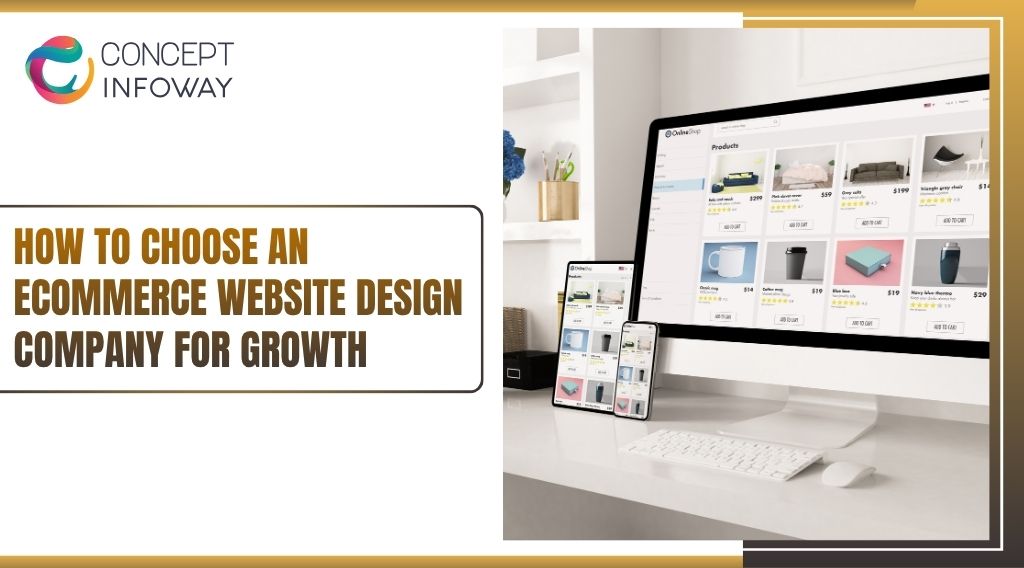
How to Choose an Ecommerce Website Design Company for Growth
An ecommerce website design company can help you turn more visits into completed purchases, but choosing the wrong partner can leave you with a polished storefront that is difficult to manage, slow on mobile devices, or disconnected from your growth goals.
The design decision affects much more than colors and page layouts; it influences trust, product discovery, checkout completion, search visibility, and the day-to-day work of your team. An ecommerce website design company should account for this requirement.
For U.S. Businesses evaluating an ecommerce Website development company, the right choice starts with business fit rather than a portfolio alone. This guide explains how to assess design expertise, ecommerce website structure, usability, technical planning, ongoing support, and measurable growth potential before selecting a partner such as Concept Infoway.
Choosing an Ecommerce Website Design Company for Growth
A growth-focused ecommerce website should make it easy for customers to understand your products, feel confident buying from you, and return when they need something else.
The ecommerce website design company you choose should understand that each of those outcomes depends on a combination of strategy, design, development, content, performance, and measurement.
Start With Your Business Model and Growth Goals
Before contacting agencies, document what the website needs to accomplish. A direct-to-consumer brand may prioritize product storytelling and repeat purchases. A B2B seller may need customer-specific pricing, quote requests, account approval, bulk ordering, or a more detailed product catalog.
A growing retailer may need a flexible ecommerce website structure that supports new categories, promotions, and inventory changes without constant redevelopment. This is an important consideration for an ecommerce website design company.
Define your current problems as specifically as possible. For example, “our website needs a redesign” is difficult for a partner to act on. “Mobile users reach product pages but rarely begin checkout” gives the team a starting point for research and testing. Other useful questions include:
- Which products or categories should drive growth?
- Where do customers abandon the buying journey?
- Which internal tasks are slow or error-prone?
- What must the website integrate with, such as inventory, email marketing, analytics, shipping, or customer support systems?
- Which markets, devices, languages, or customer segments matter most?
Your answers help separate an ecommerce website design company that understands ecommerce from one that simply produces attractive web pages.
Look for Relevant Ecommerce Experience
Ask potential partners to explain how they have handled challenges similar to yours. Relevant experience may include catalog complexity, subscription products, custom product options, wholesale purchasing, marketplace coordination, promotions, or migration from an older platform.
The goal is not to find an ecommerce website design company that has built the same website. It is to determine whether the team can recognize the risks and decisions your project will involve.
Review case studies critically. Look for evidence of the problem, the approach taken, the responsibilities of the agency, and the business or operational result.
A portfolio full of attractive homepages does not tell you whether the company understands product filtering, variant management, checkout friction, redirects, structured data, accessibility, or content administration.
A capable ecommerce website design company should also be comfortable discussing what it would not recommend. If a proposed solution is unsuitable for your catalog, internal resources, budget model, or future plans, a trustworthy partner should explain why instead of forcing every project into the same process.
Grow Your Ecommerce Business with Our Web design Services!
Get A Free QuoteWhat Should You Evaluate Before Hiring an Ecommerce Development Company?
The proposal and discovery process often reveal more than the sales presentation. Use this stage to evaluate how the team thinks, communicates, documents decisions, and manages trade-offs. You are not only buying design production; you are selecting an ecommerce website design company responsible for important customer and operational touchpoints.
Assess the Discovery and Planning Process
A strong discovery process should examine your customers, products, competitors, existing analytics, content, technology, internal workflows, and commercial priorities. It should identify the people who approve content, manage products, fulfill orders, answer customer questions, and review performance after launch.
Ask what the team will need from you and what it will deliver before visual design begins. Useful outputs may include customer journey findings, sitemap decisions, feature requirements, platform considerations, content requirements, integration questions, and a prioritized project scope. The exact deliverables will vary, but the thinking should be visible.
A capable ecommerce website design company should address this during planning.
Be cautious when a company promises to begin with design concepts without first understanding how the store works. Early visual work can create excitement, but it may conceal unresolved questions about product data, inventory, shipping rules, tax handling, customer accounts, or checkout behavior.
Resolving those questions early usually reduces rework later.
Review Design, Development, and SEO Together
Ecommerce design cannot be separated completely from development or search optimization. The ecommerce web layout affects how users move through categories, while the underlying implementation affects speed, crawlability, accessibility, tracking, and the ability of your team to maintain the store. An ecommerce website design company should account for this requirement.
Ask how the proposed team will handle:
- Responsive behavior across phones, tablets, laptops, and large screens.
- Product variants, filters, search, category pages, recommendations, and related products.
- Image optimization, performance testing, redirects, metadata, canonical handling, and structured content.
- Analytics events for product views, searches, cart actions, checkout steps, and purchases.
- Accessibility considerations, including keyboard navigation, focus states, labels, contrast, and understandable error messages.
You do not need to prescribe every technical solution before work begins. You do need confidence that design decisions will be tested in the real environment rather than presented as isolated mockups. The right ecommerce website design company should make this process clear.
Examine Communication and Ownership
Clarify who will lead the project, who makes design decisions, who handles development questions, and how approvals will work. A project can slow down when feedback is scattered across email, meetings, documents, and private messages without a clear decision owner.
Ask how changes are documented, how risks are escalated, and what happens when an integration or requirement proves more complex than expected. A professional ecommerce website design company should be able to distinguish a change in preference from a change in scope.
That distinction protects both sides and makes budget and scheduling discussions more practical.
At Concept Infoway, this type of evaluation is relevant across web design, development, SEO, and broader digital work because the final website must fit the client’s business process, not just satisfy a design review. When comparing providers, look for that same connection between recommendations and your actual operating needs.
An ecommerce website design company should account for this requirement.
According to Mordor Intelligence, the global web design market is projected to grow from USD 61.23 billion in 2025 to USD 92.06 billion by 2030, registering a compound annual growth rate (CAGR) of 8.5% during the 2025–2030 forecast period.
Ready to Grow Your Online Store? Get Expert Web Design!
Get A Free QuoteBuilding an Ecommerce Website Structure That Supports Customers and Search
A well-planned ecommerce website structure reduces the effort required to find, evaluate, and purchase a product. It also gives search engines clearer relationships between your home page, categories, subcategories, product pages, educational content, and commercial landing pages. Structure is therefore both a usability decision and a long-term growth decision.
An ecommerce website design company should account for this requirement.
Organize Products Around Customer Intent
Your internal inventory terminology may not match the language customers use. A manufacturer might organize products by model number, while buyers think in terms of application, industry, size, compatibility, or outcome. Effective planning considers both the merchandise hierarchy and the way people shop.
A capable ecommerce website design company should address this during planning.
Category pages should answer basic questions quickly: What is sold here? Who is it for? How can products be narrowed down? What makes one option different from another? If customers need to compare specifications, filters and comparison tools may be more valuable than decorative design elements.
Avoid creating a separate page for every minor variation unless that page has a clear customer and search purpose. Excessive, thin, or overlapping pages can make the store harder to maintain and may confuse both shoppers and search engines.
The best structure is usually the one that balances discovery, product clarity, inventory management, and future expansion. An ecommerce website design company should account for this requirement.
Make the Ecommerce Web Layout Predictable
Customers should not have to relearn your interface on each page. Navigation, search, product imagery, pricing, availability, calls to action, shipping information, and support options should appear in familiar locations and behave consistently.
A practical product page often needs more than a gallery and an Add to Cart button. Depending on the product, shoppers may need dimensions, materials, compatibility details, care instructions, delivery estimates, return information, reviews, financing or payment details, and answers to common questions.
Place the information in a hierarchy that supports fast scanning first, followed by deeper evaluation. A capable ecommerce website design company should address this during planning.
On mobile devices, avoid letting important information disappear behind too many expandable panels. Collapsible content can reduce clutter, but critical details such as price, selected variant, availability, and the next action should remain easy to locate.
Test with real product data rather than placeholder copy because long titles, multiple options, and unusual images often expose layout problems. The right ecommerce website design company should make this process clear.
Design the Path From Product Discovery to Checkout
The buying journey should support several entry points. A customer may arrive at a category page from search, land directly on a product page from an advertisement, or begin with an internal search after reading a guide. Each route should make the next logical step clear.
An ecommerce website design company should account for this requirement.
Review the complete path:
- Can a visitor understand the offer and locate a relevant product?
- Can the visitor compare options and resolve purchase objections?
- Can the visitor add the correct item and quantity to the cart?
- Can the visitor complete checkout without unnecessary uncertainty or repetition?
Ecommerce website usability often declines when companies add features without considering the full journey. A pop-up, cross-sell, account prompt, or promotional banner may have a legitimate purpose, but too many interruptions can compete with the purchase decision.
Ask the design team to justify each major interaction in terms of customer value and business value. A capable ecommerce website design company should address this during planning.
Plan for Content and Ongoing Administration
The website should be manageable after launch. Determine who will add products, edit prices, update inventory information, publish content, manage promotions, review orders, and monitor customer behavior. A design that looks excellent but requires developer assistance for routine changes can become expensive and slow to operate.
This is an important consideration for an ecommerce website design company.
Ask to see how content components will be reused. For example, a merchandising team may need to place a product collection on a campaign page, a category page, and an email landing page without rebuilding the same section three times.
Reusable components can improve consistency, but they should still allow enough flexibility for meaningful merchandising and content needs. This is an important consideration for an ecommerce website design company.
You may also like: Mobile App UI UX Design: How Good Design Increases App Retention Rates
Measuring Ecommerce Website Usability and Growth Potential
A new design should be evaluated by how well it supports customer and business outcomes, not by whether the launch presentation receives positive reactions. Establish measurement before development is complete so the team can identify improvements after launch instead of relying on opinions.
Define the Right Performance Indicators
Revenue is important, but it is not the only useful signal. Depending on your business model, relevant measures may include product search usage, category engagement, product-detail interactions, add-to-cart rate, checkout progression, purchase completion, average order value, repeat purchase behavior, customer service contacts, and internal time spent managing the catalog.
This is an important consideration for an ecommerce website design company.
Choose metrics that explain the journey. If purchases fall, a lower-level measure can help identify whether the issue is traffic quality, product-page clarity, cart behavior, payment options, shipping information, or technical failure. Your analytics setup should distinguish meaningful events and avoid counting accidental clicks as successful interactions.
Before launch, document the current baseline where reliable data exists. After launch, compare performance over an appropriate period and account for seasonality, promotions, product availability, traffic sources, and other business changes. A redesign alone cannot explain every change in ecommerce results.
The right ecommerce website design company should make this process clear.
Test With Real Users and Real Scenarios
Usability testing does not need to be elaborate to be useful. Ask representative customers or staff members who are not close to the project to complete realistic tasks, such as finding a compatible product, comparing two options, locating delivery information, applying a promotion, or returning to a saved cart.
Watch where participants hesitate, misinterpret labels, overlook information, or take an unexpected route. Do not ask only whether they like the design. A participant may praise the colors while still failing to find the correct variant. Behavior and comprehension provide more useful evidence than general approval.
An ecommerce website design company should account for this requirement.
Test edge cases as well. Use long product names, out-of-stock products, products with many variants, invalid addresses, coupon errors, slow connections, and interrupted checkout sessions. These situations frequently reveal weaknesses that a clean demonstration does not show.
Compare Partners on Value, Not Just Project Cost
A lower proposal may not be less expensive once you account for missing requirements, change orders, delayed content, poor tracking, or a difficult handoff. A higher proposal may also be inappropriate if it includes complex features your customers do not need.
Compare the assumptions behind each proposal rather than comparing only the final number. This is an important consideration for an ecommerce website design company.
Consider whether the scope explains research, information architecture, design, development, content migration, integrations, quality assurance, launch support, training, and post-launch improvements. Confirm which items are included, which depend on third-party systems, and which require separate decisions.
For ecommerce development services USA businesses evaluate, location is only one factor. More important questions include whether the provider understands your market, can communicate during your working hours when needed, handles data and access responsibly, and can support the technology selected for your store.
Requirements and costs may vary by platform, catalog size, integrations, and project complexity, so a credible ecommerce website design company should discuss those variables rather than offer an unsupported universal estimate.
You may also like: 7 Key Reasons Your Business Needs a Website Redesign for Better UX
Check for a Practical Post-Launch Plan
Launch is the beginning of real-world learning. Ask how defects will be reported, how analytics will be reviewed, how improvement priorities will be selected, and who will help your team make routine updates.
You may need ongoing web development, SEO, conversion improvements, content support, or technical maintenance, but the appropriate level depends on your internal capabilities and goals. A capable ecommerce website design company should address this during planning.
Concept Infoway can be a relevant option when a business wants web design and development considered together with SEO, optimization, or related digital requirements. The useful question is not whether a provider offers many services.
It is whether those services can be coordinated around your store’s actual priorities and whether the team can explain the next practical step without overpromising outcomes.
Wrapping Up
Choosing an ecommerce website design company for growth requires more than reviewing attractive examples. Evaluate how each potential partner approaches discovery, customer journeys, ecommerce website structure, mobile behavior, content administration, integrations, analytics, quality assurance, and post-launch improvement.
The strongest partner will connect design decisions to real business problems. That means making products easier to find, reducing uncertainty before checkout, giving your team practical control of the store, protecting technical quality, and creating a foundation that can adapt as your catalog and customer expectations change.
The right ecommerce website design company should make this process clear.
Prepare your goals, current performance information, product requirements, integrations, and decision criteria before you begin agency conversations. Then ask each provider to explain its recommendations in the context of your business.
Concept Infoway can support organizations evaluating web design, ecommerce development, SEO, and related digital services when that integrated perspective fits their needs. The right next step is a clear discovery conversation that identifies priorities, constraints, and the most sensible path forward.
FAQs - Ecommerce Website Design Company
What should I look for in an ecommerce website design company?
Look for proven ecommerce experience, a structured discovery process, usability and mobile expertise, SEO-aware development, clear communication, analytics planning, and support that matches your internal resources.
How is an ecommerce development company different from a web design agency?
An ecommerce development company typically handles the technical systems behind selling online, including product data, checkout, integrations, and functionality. Some agencies, including Concept Infoway, combine design and development.
Why does ecommerce website structure matter for growth?
A clear ecommerce website structure helps shoppers find products, compare options, and navigate efficiently. It also creates logical relationships between categories and products that support maintainability and search visibility.
What are the most important ecommerce website design tips for mobile shoppers?
Keep navigation clear, make search and filters usable, show price and availability prominently, optimize images, simplify forms, and make cart and checkout actions easy to find on smaller screens.
How can I evaluate ecommerce website usability before launch?
An ecommerce website design company can help evaluate usability before launch by testing realistic tasks with representative users, such as finding a product, selecting a variant, checking delivery information, and completing checkout. Review analytics and fix confusion, errors, and unnecessary steps.
How much do ecommerce development services in the USA cost?
Costs vary by platform, catalog size, custom features, integrations, content migration, and support requirements. Request a scope-based proposal that clearly separates included work from optional or third-party expenses.
Should I hire one company for ecommerce design, development, and SEO?
Using one coordinated team can reduce handoff problems when design, development, analytics, and SEO affect the same customer journey. Choose this model only if the provider can demonstrate genuine capability in each area.
Can Concept Infoway help with ecommerce website design and development?
Concept Infoway supports businesses with web design, development, SEO, optimization, and related digital services. A discovery discussion can determine which ecommerce capabilities and ongoing support fit your requirements.


.NET Migration: A Step-by-Step Guide for Businesses